
SEO Title: AI Governance Jobs 2026: Companies Hiring Responsible AI Specialists Worldwide
Focus Keyword: AI Governance Jobs 2026
Suggested URL Slug: ai-governance-jobs-2026
SEO Excerpt
AI Governance Jobs 2026: Companies worldwide are hiring professionals who can help organizations develop and deploy artificial intelligence safely, ethically and in compliance with emerging regulations. AI governance careers now span responsible AI, AI risk, model governance, privacy, compliance, policy, audit and AI security. Explore companies hiring AI governance specialists, common job titles, salary examples, qualifications, essential skills, remote opportunities and how to apply for responsible AI jobs in 2026.
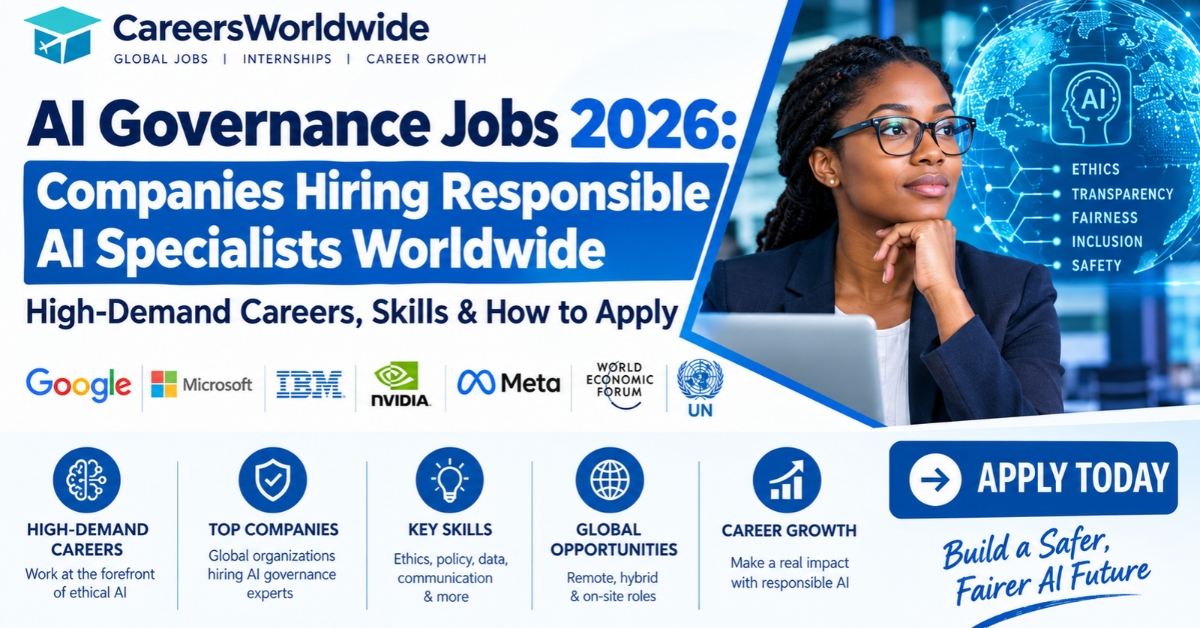
AI Governance Jobs 2026: Companies Hiring Responsible AI Specialists Worldwide
Artificial intelligence is rapidly becoming part of everyday business operations, but companies are discovering that building AI systems is only one part of the challenge.
Organizations also need professionals who can answer difficult questions:
Is an AI system safe?
Does it comply with applicable regulations?
Can the organization explain how it makes decisions?
Are customer and employee data being protected?
Are AI models being monitored for bias, security risks and unexpected behavior?
Who is accountable when an AI system produces a harmful or inaccurate result?
These questions are driving demand for a relatively new category of professional opportunity: AI governance and responsible AI jobs.
In 2026, vacancies are appearing under titles including AI Governance Manager, Responsible AI Specialist, AI Risk Manager, AI Policy Lead, AI Governance Analyst, Model Risk Manager, AI Compliance Officer, AI Governance Counsel and Responsible AI Lead.
A 2026 AI risk and compliance jobs report identified more than 1,200 roles carrying AI governance, model-risk, responsible-AI or AI-compliance terminology, with positions spread across financial services, banking, technology, healthcare, insurance, legal services and the public sector.
Current listings also demonstrate how broad the field has become. Google has advertised an Associate Principal Analyst, Responsible AI Governance, while Omnicell has advertised a remote AI Vendor Governance Manager. Wipro has also advertised an AI Governance role focused on responsible and compliant use of AI in third-party environments.
For professionals with backgrounds in technology, law, compliance, cybersecurity, data, risk management, public policy or business, this emerging field could provide a new route into the AI economy.
AI Governance Jobs 2026 — Summary Table
| Category | Details |
|---|---|
| Career Field | AI Governance & Responsible AI |
| Year | 2026 |
| Major Areas | AI risk, compliance, policy, privacy, model governance, audit and responsible AI |
| Employers | Technology companies, banks, healthcare organizations, consultancies, insurers and governments |
| Common Titles | AI Governance Analyst, AI Risk Manager, Responsible AI Lead, AI Policy Manager |
| Education | Varies by role |
| Technical Skills | AI/ML concepts, data, risk, cybersecurity and governance tools |
| Legal Skills | AI regulation, privacy, compliance and policy |
| Experience | Entry-level to executive positions |
| Work Models | On-site, hybrid and remote depending on employer |
| Salary | Varies significantly by country, employer and seniority |
| Application Method | Official company career portals |
| Demand | Growing across multiple industries |
What Is AI Governance?
AI governance refers to the policies, processes, controls and accountability mechanisms organizations use to manage artificial intelligence responsibly.
It sits at the intersection of several disciplines.
These can include:
- Artificial intelligence
- Machine learning
- Cybersecurity
- Data governance
- Privacy
- Risk management
- Compliance
- Law
- Ethics
- Public policy
- Internal audit
A responsible AI professional may therefore not need to be a machine-learning engineer.
Instead, the person might specialize in understanding how AI systems should be assessed, documented, monitored and controlled.
Why Are AI Governance Jobs Growing in 2026?
The rapid adoption of AI is creating new organizational risks.
Companies are deploying:
- Generative AI
- Large language models
- AI assistants
- Automated decision systems
- Predictive analytics
- AI-powered customer services
- AI recruitment systems
- AI cybersecurity tools
- AI-powered financial systems
As adoption increases, companies need frameworks for managing these systems.
Regulatory requirements are another major factor.
Organizations operating across different countries increasingly need to understand how AI-related rules affect their products and internal operations.
The result is an expanding need for professionals who understand both AI and organizational risk.
Top AI Governance Job Titles in 2026
The terminology is still evolving.
Two organizations may perform similar work under completely different job titles.
Common titles include:
AI Governance Analyst
This is often an entry-to-mid-level position supporting governance processes.
Responsibilities may include:
- Maintaining AI inventories
- Tracking risk assessments
- Supporting governance documentation
- Monitoring compliance
- Preparing reports
- Supporting policy implementation
AI Governance Manager
Managers typically oversee AI governance programmes.
Responsibilities can include:
- Developing governance frameworks
- Managing AI risk processes
- Coordinating stakeholders
- Establishing AI controls
- Reviewing AI systems
- Managing governance teams
Responsible AI Specialist
Responsible AI specialists focus on ensuring that AI is developed and deployed in accordance with principles such as:
- Fairness
- Transparency
- Accountability
- Safety
- Privacy
- Human oversight
AI Risk Manager
AI risk managers identify and assess risks associated with AI systems.
This can involve:
- Model risk
- Operational risk
- Regulatory risk
- Cybersecurity risk
- Privacy risk
- Third-party risk
AI Compliance Officer
These professionals focus on whether AI systems comply with applicable laws, regulations, policies and organizational standards.
AI Policy Manager
AI policy professionals analyze regulations and help organizations translate them into practical internal policies.
AI Governance Counsel
Lawyers are increasingly entering AI governance.
Their responsibilities can include:
- AI regulation
- Privacy
- Product compliance
- Contracts
- Regulatory interpretation
- Corporate policies
- Risk management
Companies Hiring for AI Governance and Responsible AI Roles
The field is no longer limited to AI laboratories.
AI governance jobs are appearing across technology, finance, healthcare, consulting, insurance, telecommunications and government.
Below are some employers and current examples worth monitoring.
1. Google — Responsible AI Governance Careers
Google is one of the most visible technology employers in the responsible AI space.
Google’s careers platform has listed an Associate Principal Analyst, Responsible AI Governance role, demonstrating that AI governance is being integrated into large technology organizations as a specialized professional function.
Google’s broader careers listings also include AI safety and security positions.
Potential Google AI Governance Areas
Professionals may encounter opportunities involving:
- Responsible AI
- AI policy
- AI risk
- AI safety
- Privacy
- Trust and safety
- Compliance
- Data governance
Who Should Consider Google?
Candidates with backgrounds in:
- Computer science
- AI
- Data science
- Law
- Public policy
- Risk
- Compliance
- Ethics
- Security
may find relevant opportunities.
Official careers: Google Careers
2. Microsoft — AI Governance, Safety & Compliance
Microsoft is another major employer where AI governance intersects with technology, security and compliance.
Microsoft’s AI organization works across areas such as AI infrastructure, model development and governance.
A Microsoft AI infrastructure posting, for example, describes systems connecting data acquisition, governance and compliance with training, evaluation and data improvement, while emphasizing security, policy compliance, rights awareness, traceability and auditability.
This illustrates how governance can become embedded directly into technical AI infrastructure.
Potential Career Areas
Candidates can look for:
- Responsible AI
- AI safety
- AI security
- Data governance
- Privacy
- Compliance
- AI policy
- Technical programme management
3. Wipro — AI Governance & GRC
AI governance is also becoming important within technology consulting.
Wipro recently listed a GRC AI Governance position in Bengaluru.
The posting describes an AI Governance Support Specialist / Analyst function focused on safe, fair and legal use of AI in third-party environments. Responsibilities include maintaining an AI inventory and risk logs.
This is an important example because it demonstrates that AI governance is not only an internal function at major AI companies.
Consulting and technology-services organizations also need professionals who can help their clients establish AI controls.
Relevant Skills
Candidates may benefit from:
- GRC
- Risk management
- Compliance
- AI fundamentals
- Third-party risk
- Data governance
- Cybersecurity
4. Omnicell — AI Vendor Governance
Omnicell has advertised a remote AI Vendor Governance Manager position in the United States.
The role sits within the Legal Department and focuses on how AI enters the company through third parties.
Responsibilities include designing and operating third-party intake processes, identifying AI solutions, evaluating risk and establishing risk-tiering and review workflows.
This is an excellent example of how AI governance intersects with:
- Procurement
- Legal
- Privacy
- Security
- Quality
- Vendor management
- Enterprise risk
Remote Opportunity
The Omnicell listing identifies the role as Remote, showing that at least some AI governance positions can be performed outside a traditional office environment.
5. Financial Services Companies
Financial institutions are becoming major employers of AI governance professionals.
Banks and investment companies already have extensive risk-management frameworks.
AI introduces another layer of complexity.
Potential roles include:
- AI Model Risk Manager
- AI Risk Specialist
- AI Governance Lead
- Responsible AI Manager
- AI Compliance Officer
- Data & AI Governance Lead
A 2026 AI risk and compliance report found financial services to be a leading sector for AI compliance roles, while banking was identified as a major sector for model-risk positions.
This makes banking and financial services particularly attractive for professionals who already understand risk management.
6. Healthcare Companies
Healthcare organizations have a strong need for AI governance because AI can affect sensitive data and high-impact decisions.
Possible applications include:
- Medical diagnostics
- Patient data
- Clinical decision support
- Healthcare administration
- Insurance
- Research
Healthcare AI governance professionals may therefore need knowledge of:
- Data privacy
- Clinical risk
- AI ethics
- Regulatory compliance
- Cybersecurity
- Data governance
7. Consulting Firms
Large consulting organizations are also developing AI governance practices.
Potential employers include:
- Accenture
- Deloitte
- PwC
- EY
- KPMG
Consulting roles can be attractive because professionals may work with multiple organizations rather than supporting only one internal AI programme.
A specialist AI governance consultant might help a client:
- Identify AI systems.
- Assess risks.
- Develop policies.
- Establish governance committees.
- Implement controls.
- Prepare regulatory documentation.
- Monitor AI systems.
AI Governance Jobs Can Be Remote
Remote work is available in parts of the AI governance market.
Current listings show remote or hybrid roles in areas such as:
- AI governance
- AI risk
- Responsible AI
- Privacy
- Compliance
- AI policy
A 2026 AI risk and compliance report estimated that 34% of the roles it analyzed were remote-eligible, although the figure applies to its dataset rather than the entire global market.
The actual availability of remote work depends heavily on the employer, country and sensitivity of the role.
AI Governance Salary Expectations
AI governance compensation varies considerably.
There is no universal salary because these professionals can come from very different backgrounds.
A senior AI governance lawyer may earn very differently from an entry-level governance analyst.
Current listings illustrate this range.
Examples from current AI governance listings include:
- Risk Manager, AI & GenAI Model Risk: $108,000–$162,000
- AI Governance Advisor: $170,000–$180,000
- Head of AI Governance: $152,000–$250,000
- Director, AI Governance Attorney: $207,000–$363,000
These are examples from specific U.S. vacancies and should not be interpreted as a universal AI governance salary range.
Salary depends on:
- Country
- Employer
- Seniority
- Technical expertise
- Legal qualifications
- Industry
- Location
- Scope of responsibility
Entry-Level AI Governance Jobs
One misconception is that every AI governance job requires ten years of experience.
That is not necessarily the case.
The field includes positions such as:
- AI Governance Analyst
- AI Compliance Analyst
- AI Risk Analyst
- Data Governance Analyst
- Responsible AI Analyst
- Technology Risk Analyst
The 2026 AI risk and compliance report identified AI Governance Analyst roles across the entry-to-mid-level range.
Candidates can therefore enter the field through adjacent disciplines.
How to Enter an AI Governance Career
You do not necessarily need a PhD in artificial intelligence.
There are several possible routes.
Route 1: Technology → AI Governance
A software engineer or data scientist can transition into governance by learning:
- AI risk
- Compliance
- AI policy
- Documentation
- Responsible AI
- Model governance
Route 2: Law → AI Governance
Lawyers can specialize in:
- AI regulation
- Privacy
- Technology law
- Product compliance
- AI contracts
- Digital policy
Route 3: Cybersecurity → AI Governance
Cybersecurity professionals can specialize in:
- AI security
- Model security
- AI threat assessments
- Third-party AI risk
- Security controls
Route 4: Risk & Compliance → AI Governance
Professionals in:
- Enterprise risk
- Compliance
- Internal audit
- Financial risk
- GRC
can build AI expertise and transition into AI governance.
Route 5: Data Governance → AI Governance
Data governance is closely connected to AI governance.
Professionals who understand:
- Data quality
- Data ownership
- Data lineage
- Privacy
- Data controls
can develop additional AI knowledge.
Skills Employers Want in AI Governance Professionals
AI Fundamentals
You should understand basic concepts such as:
- Machine learning
- Generative AI
- Large language models
- Training data
- Model evaluation
- AI agents
You do not necessarily need to build models yourself.
Risk Management
You should understand how to identify and assess risk.
Relevant concepts include:
- Risk assessments
- Risk registers
- Controls
- Mitigation
- Monitoring
- Risk acceptance
Regulatory Knowledge
Understanding AI regulations can be highly valuable.
Candidates should monitor developments involving:
- AI regulation
- Privacy
- Data protection
- Consumer protection
- Sector-specific requirements
Documentation
AI governance depends heavily on documentation.
Professionals may prepare:
- AI inventories
- Risk assessments
- Policies
- Model cards
- Impact assessments
- Audit evidence
- Compliance reports
Communication
AI governance professionals frequently work across departments.
They may communicate with:
- Engineers
- Lawyers
- Executives
- Security teams
- Product managers
- Compliance teams
- Auditors
Strong communication skills are therefore essential.
Certifications That Can Help
Certifications are not mandatory for every position, but relevant credentials can strengthen an application.
Potential areas include:
- AI governance
- Information security
- Privacy
- Risk management
- Audit
- Data governance
Candidates should choose certifications based on their existing career path rather than collecting credentials without practical experience.
AI Governance vs Responsible AI
These terms are closely related but not identical.
Responsible AI generally focuses on principles and practices for developing and deploying AI responsibly.
This can include:
- Fairness
- Explainability
- Safety
- Human oversight
- Transparency
AI governance is broader.
It can include:
- Policies
- Accountability
- Risk management
- Compliance
- Controls
- Auditing
- AI inventories
- Regulatory processes
The two fields overlap heavily, and employers frequently use the terminology differently.
AI Governance vs AI Engineering
AI engineers build AI systems.
AI governance professionals help ensure those systems are developed and deployed responsibly.
For example:
AI Engineer: Builds a machine-learning model.
AI Governance Specialist: Helps determine how that model should be assessed, documented, monitored and controlled.
Both functions can work closely together.
How to Apply for AI Governance Jobs in 2026
Step 1: Choose Your Specialization
Decide whether you want to focus on:
- AI risk
- Responsible AI
- AI compliance
- AI policy
- AI security
- Privacy
- Model governance
Step 2: Build AI Knowledge
Learn the fundamentals of AI and machine learning.
Step 3: Develop Governance Skills
Learn how organizations use:
- Risk frameworks
- Controls
- Policies
- Audits
- Compliance processes
Step 4: Search Multiple Job Titles
Do not search only for “AI Governance Specialist.”
Also search:
- Responsible AI
- AI Risk
- AI Compliance
- AI Policy
- Model Risk
- AI Assurance
- AI Audit
- AI Safety
- Data & AI Governance
Step 5: Tailor Your CV
Highlight relevant experience in:
- Risk
- Compliance
- Technology
- Data
- Law
- Security
- Governance
Step 6: Apply Through Official Career Websites
Always verify the vacancy and submit through the employer’s official recruitment system.
Who Should Apply for AI Governance Jobs?
These careers can be suitable for professionals from many backgrounds.
Technology Professionals
Software engineers, data scientists and AI specialists can move toward governance.
Lawyers
Technology and privacy lawyers can specialize in AI regulation.
Compliance Professionals
Compliance officers can develop AI-specific expertise.
Cybersecurity Professionals
Security professionals can specialize in AI security and AI risk.
Risk Professionals
Enterprise and model-risk specialists can transition into AI governance.
Data Professionals
Data governance specialists can expand into AI governance.
Public Policy Professionals
Policy professionals can work on AI regulation and government strategy.
Important AI Governance Job Search Keywords
When searching for vacancies, use several variations.
Try:
- AI Governance Jobs
- Responsible AI Jobs
- AI Risk Jobs
- AI Compliance Jobs
- AI Policy Jobs
- AI Safety Jobs
- AI Assurance Jobs
- AI Audit Jobs
- Model Risk Jobs
- AI Governance Analyst
- AI Governance Manager
- Responsible AI Specialist
- AI Risk Manager
- AI Compliance Officer
- AI Policy Manager
- AI Governance Counsel
- Data & AI Governance
- AI GRC Jobs
This is important because companies do not use a standardized job-title system.
Frequently Asked Questions
What are AI governance jobs?
AI governance jobs involve creating and implementing policies, controls and processes that help organizations develop and use AI safely, responsibly and in compliance with applicable requirements.
Is AI governance a good career in 2026?
It is an emerging career field with opportunities across technology, finance, healthcare, consulting, insurance and government. Current listings show demand across multiple sectors.
Do I need to know how to code?
Not necessarily. Some roles are highly technical, while others focus on policy, risk, legal or compliance work.
Do I need an AI degree?
No. Relevant backgrounds can include computer science, law, cybersecurity, data governance, risk, compliance and public policy.
Can lawyers work in AI governance?
Yes. AI governance increasingly overlaps with privacy, regulation, contracts and technology law.
Can cybersecurity professionals work in AI governance?
Yes. AI security, third-party AI risk and model security are relevant areas.
Are AI governance jobs remote?
Some are. Current listings include remote and hybrid opportunities, although location requirements vary by position.
How much do AI governance professionals earn?
Compensation varies significantly. Current U.S. listings show salaries ranging from roughly six figures for some specialist roles to substantially higher compensation for senior leadership and legal positions.
What is responsible AI?
Responsible AI refers to developing and deploying AI in ways that emphasize principles such as fairness, transparency, safety, accountability and human oversight.
What is AI risk?
AI risk involves identifying and managing potential negative outcomes associated with AI systems, including model, regulatory, privacy, security and operational risks.
Which companies hire AI governance professionals?
Technology companies, banks, insurers, healthcare organizations, consulting firms, telecommunications companies and government institutions are all potential employers.
Can beginners enter AI governance?
Yes. Entry-level and mid-level governance positions exist, although requirements vary. Building a foundation in AI, risk, compliance or data governance can help.
Final Thoughts
AI Governance Jobs 2026 represent one of the emerging career paths created by the rapid adoption of artificial intelligence.
As organizations deploy more AI systems, they need professionals who can help answer the questions that engineers alone cannot solve.
Who is responsible?
What risks does the system create?
How should it be monitored?
What documentation is required?
Does it comply with applicable requirements?
How should organizations respond when something goes wrong?
These questions are creating opportunities for professionals from technology, law, cybersecurity, compliance, risk management, data governance and public policy.
Current vacancies demonstrate that the field is already broader than the technology sector. AI governance roles are appearing in financial services, healthcare, consulting, telecommunications and other industries.
Google, for example, has advertised dedicated Responsible AI Governance positions, while Wipro and Omnicell have advertised roles focused on AI governance and third-party AI risk.
For job seekers, the key is not to search for one title.
Search across AI governance, responsible AI, AI risk, AI compliance, AI policy, model risk, AI assurance, AI audit and data & AI governance.
The professionals best positioned for this market will be those who can combine AI literacy with practical knowledge of risk, regulation, security, privacy and organizational governance.
🚀 APPLY NOW
Search current vacancies through the official careers pages of companies hiring in AI, technology, risk and governance. Always verify the vacancy and application deadline directly with the employer before applying.
SEO Keywords
AI Governance Jobs 2026, AI governance jobs, responsible AI jobs 2026, responsible AI careers, AI governance careers, AI governance specialist jobs, AI governance analyst jobs, AI governance manager jobs, AI risk jobs 2026, AI compliance jobs, AI policy jobs, AI safety jobs, AI assurance jobs, AI audit jobs, model risk jobs, responsible AI specialist, responsible AI lead, AI compliance officer, AI policy manager, AI governance counsel, AI risk manager, AI governance analyst, AI governance manager, data and AI governance jobs, AI GRC jobs, AI ethics jobs, artificial intelligence governance careers, AI regulation jobs, AI privacy jobs, AI security governance jobs, AI jobs 2026, artificial intelligence jobs 2026, high paying AI jobs, remote AI governance jobs, remote responsible AI jobs, global AI jobs, AI governance jobs worldwide, Google AI governance jobs, Microsoft AI governance jobs, Wipro AI governance jobs, AI vendor governance jobs, AI risk management careers, model governance careers, AI compliance careers, responsible artificial intelligence jobs, future AI careers, emerging AI jobs 2026.
ALSO CHECK : Top 7 Companies Offering Paid Internships in 2026: Competitive Stipends, Global Opportunities & Career PathsSeptember 2, 2026
U.S. Embassy Jobs 2026: Multiple Career Opportunities Hiring Now — Requirements, Benefits & How to ApplySeptember 1, 2026