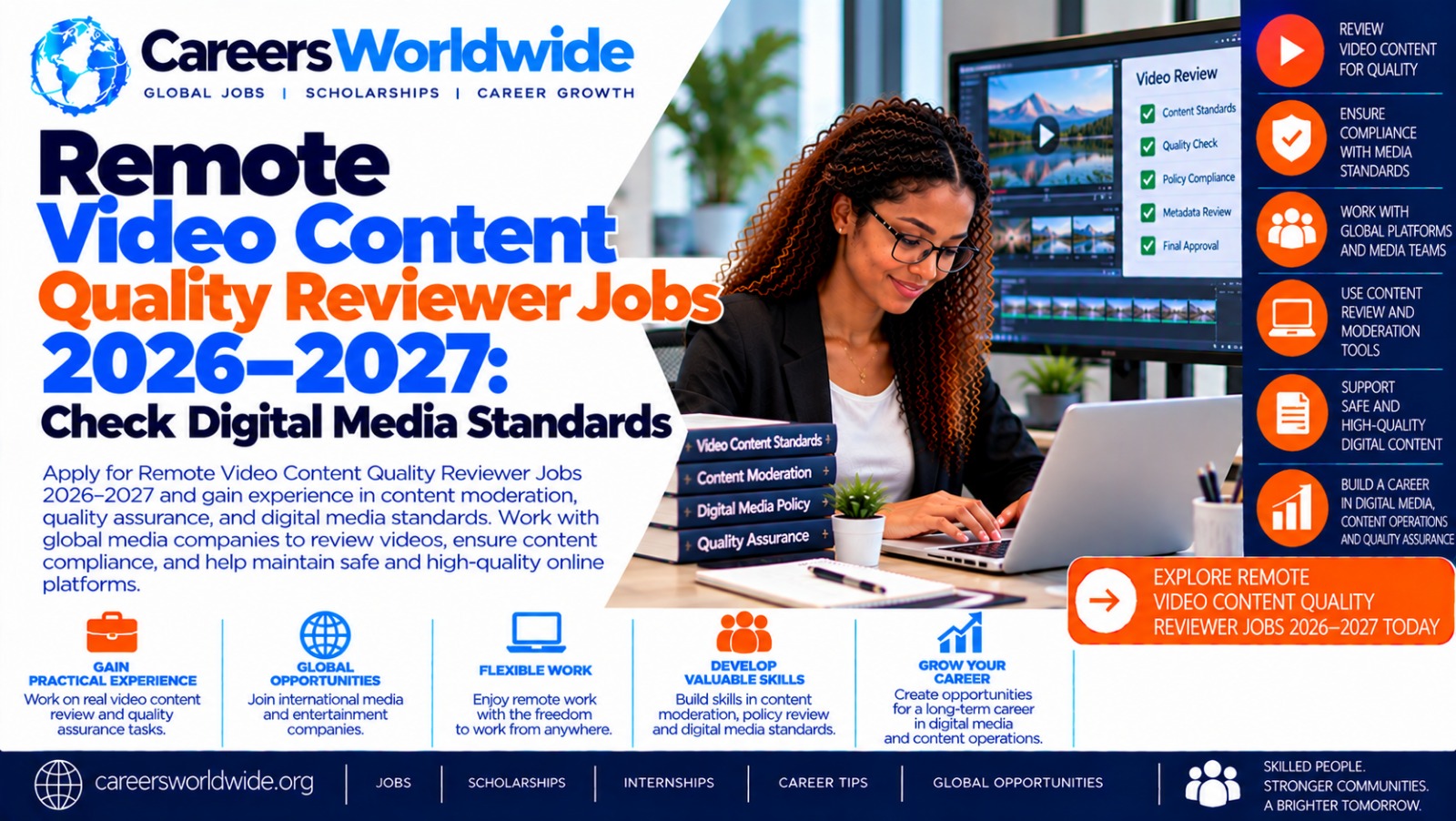

Excerpt: Remote Video Content Quality Reviewer jobs in 2026–2027 offer a potential pathway into digital media quality assurance, content evaluation, and AI-assisted media review. These roles may involve checking video clarity, audio synchronization, captions, visual consistency, relevance, and compliance with project-specific standards. Opportunities vary by employer, country, language, and experience level, and not every position is fully remote or continuously available. This guide explains the responsibilities, essential skills, eligibility requirements, application process, expected work arrangements, official job-search resources, and practical steps candidates can take to prepare for legitimate remote video review opportunities.
Remote Video Content Quality Reviewer Jobs 2026–2027: An Overview
Digital video is used across entertainment platforms, educational websites, social media, advertising, online marketplaces, and artificial intelligence (AI) development. As the volume of video content increases, businesses need people who can assess whether digital media meets defined quality requirements.
A Remote Video Content Quality Reviewer evaluates video files, recorded material, or video-related search results against instructions supplied by an employer or project owner. Depending on the assignment, the work may include identifying technical defects, checking captions, evaluating relevance, documenting inconsistencies, or assessing whether content follows established guidelines.
For 2026–2027, job seekers may encounter related positions advertised under different titles, including Video Quality Reviewer, Media Quality Analyst, Video Content Evaluator, Digital Media Reviewer, Media Search Analyst, AI Video Evaluator, and Content Quality Assurance Associate.
These titles are not interchangeable in every case. A media search analyst may evaluate search results and relevance, while a production quality reviewer may concentrate on editing, audio, and visual presentation. A content moderation specialist may instead assess material against safety policies.
Important: “Remote Video Content Quality Reviewer Jobs 2026–2027” is a useful job-search topic, not a guarantee that a particular employer has an opening under that exact title. Applicants should verify each vacancy through the employer’s official careers website and check whether their country is eligible.
1. What Does a Remote Video Content Quality Reviewer Do?
A video content quality reviewer helps ensure that digital media meets a specified standard before it is accepted, published, indexed, or used in a technology project.
The exact duties depend on the assignment. Common responsibilities may include:
- Checking visual quality: Identifying blurry images, distorted frames, unexpected black screens, inconsistent brightness, or other visible defects.
- Reviewing audio: Detecting missing sound, distracting background noise, poor synchronization, sudden volume changes, or unclear speech.
- Checking captions and subtitles: Looking for spelling mistakes, missing dialogue, incorrect timing, and discrepancies between spoken words and displayed text.
- Assessing relevance: Determining whether a video, thumbnail, title, or search result matches the task instructions.
- Following quality guidelines: Applying a scoring rubric consistently instead of relying only on personal preferences.
- Documenting errors: Recording timestamps, describing the problem, and assigning the appropriate error category.
- Reviewing AI-generated media: Where the project involves AI, evaluating generated or edited video against reference examples, technical requirements, and project-specific criteria.
- Supporting quality assurance: Reporting recurring problems and helping teams identify areas that need improvement.
For example, a reviewer might inspect a two-minute instructional video and notice that the subtitles appear several seconds after the speaker finishes a sentence. The reviewer records the timestamp, selects the relevant error category, and explains the discrepancy.
Another project might ask the reviewer to compare a video thumbnail with the actual clip and determine whether the thumbnail accurately represents the content.
The objective is to make consistent, evidence-based judgments—not to criticize creative choices simply because they differ from personal taste.
2. Why Consider Video Quality Reviewer Jobs in 2026–2027?
Remote media evaluation may appeal to people interested in digital technology, online content, language, editing, and quality assurance.
Several characteristics make these roles worth investigating.
Potential flexibility: Some project-based positions let qualified workers complete tasks within an agreed availability window rather than following a traditional office schedule. However, other positions require fixed shifts, minimum weekly hours, or specific time-zone coverage.
Accessible transferable skills: Attention to detail, written communication, careful observation, and the ability to follow instructions can be relevant even when a candidate has limited formal video-production experience.
Exposure to AI evaluation: Some assignments involve evaluating AI-generated media, checking model outputs, or providing structured feedback that supports improvements to automated systems.
A range of specializations: Candidates may explore technical quality assurance, media search evaluation, caption verification, trust and safety, or production review, depending on their background.
Potential entry points into digital work: Experience with structured evaluation, documentation, and quality control may be useful when applying for other digital operations or media-related positions.
Nevertheless, remote work is not automatically easy, permanent, or well paid. Some projects have limited task availability, competitive selection processes, unpaid qualification assessments, or short contracts. Applicants should examine the actual terms before accepting an assignment.
3. Skills and Qualifications Employers May Look For
Requirements vary significantly by employer and project. Some positions prioritize language and local cultural knowledge; others expect experience with video editing, technical troubleshooting, or content moderation.
Essential skills
Attention to detail: Reviewers must notice small but meaningful problems, such as a missing caption, a frozen frame, an incorrect label, or a mismatch between a title and the video.
Written communication: Candidates may need to explain findings in concise, understandable language. A useful report identifies the problem, its location, and the relevant standard.
Consistency: Similar cases should receive similar ratings when the same guidelines apply.
Digital literacy: Comfort using browsers, online dashboards, file viewers, spreadsheets, and workplace communication tools can be valuable.
Time management: Remote workers need to organize their workload, meet deadlines, and avoid sacrificing accuracy for speed.
Instruction-following: Reviewers must apply the project’s rules even when those rules differ from their personal preferences.
Additional qualifications that may help
- Experience with video editing or production.
- Familiarity with subtitle formats and caption timing.
- Knowledge of image and audio quality concepts.
- Previous work in quality assurance, data annotation, or content moderation.
- Experience evaluating search results or digital media relevance.
- Strong command of the required language.
- Familiarity with spreadsheets and structured reporting.
A degree in film, media studies, communications, or information technology may be useful for some technical roles, but it is not a universal requirement.
Applicants should never assume that every reviewer vacancy is entry-level. Read the eligibility section carefully and distinguish essential qualifications from desirable ones.
4. Equipment and Internet Requirements
Remote video review requires a dependable working environment. The specific technical requirements should be confirmed in the vacancy or onboarding documentation.
| Requirement | Practical recommendation |
|---|---|
| Computer | A reliable laptop or desktop compatible with the employer’s platform |
| Internet | A stable connection suitable for streaming or downloading assigned files |
| Display | A screen large enough to inspect video details and read review instructions |
| Audio | Working headphones or speakers for checking dialogue and synchronization |
| Workspace | A quiet, organized area with limited distractions |
| Software | An up-to-date browser and any employer-approved review tools |
| Security | Device protection, secure passwords, and compliance with confidentiality rules |
| Power | A reliable power supply or backup arrangement where practical |
A high-end video-editing workstation is not necessarily required for a basic evaluation project. Conversely, a technical quality assurance role may require particular software, processing capability, or a specified display setup.
Do not purchase expensive equipment simply because an unofficial recruiter recommends it. Confirm the requirements directly with the employer before spending money.
5. Salary, Working Hours, and Employment Type
Compensation is one of the most important details to verify when comparing remote video reviewer opportunities.
There is no single reliable salary that applies to all Remote Video Content Quality Reviewer jobs for 2026–2027. Earnings depend on the employer, country, project budget, required expertise, contract type, and payment method.
A position may pay by the hour, per completed task, per accepted unit of work, or through a fixed salary. Some independent contractor projects pay only for approved work rather than all time spent online.
Before accepting an offer, establish:
- The stated hourly rate or task-based payment.
- Whether training, qualification tests, and meetings are paid.
- The expected workload and whether tasks are guaranteed.
- The payment schedule and available payment methods.
- Any minimum performance requirements.
- Whether taxes, equipment, internet, and transaction fees are your responsibility.
- Whether the engagement is employment, freelance contracting, or temporary project work.
Working hours can also vary. Some projects offer flexible task windows, while others require scheduled availability or a minimum number of hours per week.
Candidates applying internationally should confirm whether the employer accepts residents of their country, whether the advertised currency is appropriate for their contract, and whether local tax or work-authorization requirements apply.
Avoid job advertisements promising unusually high guaranteed income for minimal work without clearly identifying the employer, duties, payment conditions, and selection process.
6. How to Find Legitimate Remote Video Reviewer Vacancies
The most effective approach is to search for both the exact title and related job categories.
Start with official employer career portals rather than relying entirely on social media posts, copied advertisements, or third-party recruitment pages.
Useful search terms include:
- Remote Video Content Quality Reviewer
- Video Quality Assurance Reviewer
- Remote Media Quality Analyst
- Video Content Evaluator
- Media Search Analyst
- Remote AI Video Evaluator
- Digital Content Quality Assurance
- Remote Subtitle Quality Reviewer
- Video Annotation Specialist
- Content Review Associate
Different employers use different terminology, so a search limited to one job title may miss relevant positions.
Employers and resources worth checking
TELUS Digital AI Community: TELUS Digital advertises project-based roles involving online evaluation and media search. Its Media Search Analyst listings describe assessing media relevance and providing feedback to improve search systems. Availability and eligibility depend on the particular listing.
Official careers resource: https://jobs.telusdigital.com/
Google Careers: Google maintains an official careers portal for positions within Google and its associated teams. Search for relevant quality assurance, media, operations, and content-related positions, while recognizing that many opportunities will have different responsibilities from freelance media rating.
Official careers resource: https://careers.google.com/
RWS Careers: RWS recruits for a range of language, localization, AI data, and related project opportunities. Candidates can search for relevant evaluation or language-based work, although a dedicated video reviewer vacancy may not be available.
Official careers resource: https://www.rws.com/about/careers/
These are starting points for research, not confirmation that all three organizations currently have an opening with the exact title used in this article. Search the live vacancy listings and review the full job description before applying.
A legitimate listing should explain the work, eligibility criteria, contract arrangement, and application process clearly enough for a candidate to make an informed decision.
7. Practical Guidance for Preparing a Strong Application
A well-prepared application helps recruiters understand how your skills match the role. You do not need to describe yourself as a professional video editor if your experience is primarily administrative, analytical, or language-based. Instead, emphasize relevant abilities you can demonstrate.
Step 1: Prepare a targeted CV
Keep your CV clear, accurate, and easy to scan. Include your contact information, relevant skills, work experience, education where applicable, and language proficiency.
Useful skills to highlight include:
- Quality checking and error identification.
- Video, audio, or caption review.
- Data annotation and content evaluation.
- Accurate recordkeeping and written reporting.
- Attention to detail and consistent decision-making.
- Independent remote work and deadline management.
If you have no direct experience, include genuine examples of related work. For instance, you might describe checking documents for errors, reviewing website content, transcribing audio, or maintaining accurate digital records.
Do not invent clients, previous employment, certificates, or performance statistics.
Step 2: Write a concise application statement
Explain why the position interests you and how your skills relate to its responsibilities. Mention the relevant language, technical experience, or quality assurance skills requested in the advertisement.
Avoid generic claims such as “I can do any online job.” A specific statement about your ability to follow evaluation guidelines, identify inconsistencies, and document findings is more useful.
Step 3: Read the eligibility requirements
Check the accepted countries, language requirements, age requirements where lawful, computer specifications, working-hour expectations, and contract conditions.
A vacancy described as remote may be restricted to applicants living in a particular country. Remote does not necessarily mean worldwide.
Step 4: Complete any assessment honestly
Some evaluation projects require applicants to complete a qualification test or sample task. Read the instructions carefully, use the supplied rubric, and explain your decisions clearly when asked.
Do not share confidential test materials or seek unauthorized access to a company’s internal systems.
Step 5: Keep records of applications
Maintain a simple spreadsheet containing the company, job title, application date, official vacancy link, location restrictions, contract type, and application status.
This makes it easier to follow up and identify duplicate or suspicious advertisements.
8. How to Apply for Remote Video Content Quality Reviewer Jobs
The following process provides a practical starting point for candidates searching during 2026–2027.
1. Open an official careers portal. Begin with the employer’s verified website and navigate to its jobs or careers section.
2. Search for suitable titles. Try “video reviewer,” “media search analyst,” “content quality,” “AI evaluator,” and “quality assurance.” Compare the responsibilities rather than relying on the title alone.
3. Filter for remote opportunities. Check the location filter and read the residency requirements. Confirm that applicants from your country are accepted.
4. Review the complete vacancy. Look for qualifications, working hours, compensation, equipment requirements, contract duration, and closing dates, if stated.
5. Prepare your application documents. Upload an accurate CV and provide any requested information. Tailor your application to the actual role.
6. Complete the screening process. If invited, follow the employer’s instructions for interviews, assessments, identity verification, or onboarding. Verify the legitimacy of any communication requesting sensitive information.
7. Review the contract before starting. Confirm payment terms, task acceptance rules, confidentiality requirements, and how to contact support.
8. Save the confirmation. Keep a copy of the application confirmation and the vacancy description where permitted.
What if there is no suitable vacancy?
Do not assume that an application has been accepted simply because you completed a form on a recruitment website. Check for an acknowledgment from the employer and monitor its official careers portal.
You can also set up job alerts where the platform supports them. Search related job categories periodically because project availability and eligibility can change throughout the year.
9. A Simple Example of Video Quality Review
Imagine that a project asks you to assess a short educational video using four criteria: visual clarity, audio quality, caption accuracy, and relevance.
Your task is to apply the specified scoring rules, not to redesign the video.
| Quality criterion | Example issue | Appropriate reviewer action |
|---|---|---|
| Visual clarity | A section becomes blurred | Record the timestamp and select the relevant defect category |
| Audio quality | Speech becomes difficult to hear | Identify the affected section and describe the audio problem |
| Caption accuracy | A displayed word differs from the spoken word | Record the discrepancy and follow the caption-review rules |
| Relevance | The video does not match the assigned topic | Explain the mismatch using the project’s relevance criteria |
Suppose the captions are accurate overall, but one sentence appears too early. You should document the specific timing issue instead of labeling the entire video as poor quality without justification.
Likewise, if a video uses a creative transition that is unfamiliar to you but complies with the project’s requirements, personal preference alone is not a valid reason to mark it as defective.
Good review work is specific, consistent, reproducible, and grounded in the supplied standards.
10. Avoiding Remote Job Scams
Remote job seekers should take care when responding to advertisements shared through messaging apps, social media, email, and unofficial recruitment websites.
Warning signs include:
- Requests for upfront recruitment fees or deposits.
- Promises of guaranteed earnings without a credible contract.
- Requests to purchase equipment from a recruiter-selected vendor using your own money.
- Unsolicited offers that bypass a meaningful application process.
- Email addresses or websites that imitate a legitimate company’s branding.
- Requests for passwords, verification codes, or unnecessary financial information.
- Pressure to make immediate payments to secure a position.
- Instructions to receive and transfer money on behalf of someone else.
A professional-looking website or an offer letter displaying a familiar company logo is not proof that an opportunity is genuine.
Verify the vacancy through the employer’s official website. If a recruiter contacts you independently, confirm that the role exists and that the communication channel is legitimate before providing sensitive documents.
For additional guidance, consult the US Federal Trade Commission’s job scam advice. Its guidance is useful for recognizing common fraud patterns, although applicants should also follow the consumer-protection and reporting procedures applicable in their own country.
Never pay someone simply because they promise to guarantee selection for a remote reviewer position.
11. Building Long-Term Skills in Digital Media Quality Assurance
Candidates who want to develop beyond entry-level evaluation can strengthen their knowledge of media quality, structured reporting, and digital workflows.
Begin by learning basic concepts such as frame rate, resolution, aspect ratio, audio synchronization, compression artifacts, and subtitle timing. You do not necessarily need advanced editing software to understand these concepts.
Practice writing objective observations. Instead of saying, “This video is bad,” describe the actual issue: “The audio becomes noticeably quieter at approximately 00:42, making the final sentence difficult to hear.”
You can also develop spreadsheet skills for organizing review results, identifying recurring errors, and tracking completed assignments.
For those interested in AI-related projects, it may help to understand how human evaluators compare outputs, apply rating rubrics, identify inconsistencies, and record decisions. Employers may provide training, but the availability and scope of that training vary.
Finally, learn to manage repetitive work without losing accuracy. Take permitted breaks, protect confidential material, and follow escalation procedures when the guidelines do not clearly cover an issue.
These habits can support applications for related roles in digital operations, media quality assurance, localization, data annotation, and content evaluation. They do not guarantee employment, but they can make your skills easier to demonstrate.
12. Official Application Resources for 2026–2027
Use the following links to investigate legitimate vacancies and related opportunities. Each portal may contain many job categories, and listings can open, close, or change their eligibility requirements.
- TELUS Digital Careers: https://jobs.telusdigital.com/ — Search for Media Search Analyst, AI Community, and relevant quality evaluation opportunities.
- Google Careers: https://careers.google.com/ — Search for quality assurance, media operations, content-related, and other relevant positions.
- RWS Careers: https://www.rws.com/about/careers/ — Investigate localization, language services, AI data, and related project opportunities.
- FTC Job Scam Guidance: https://consumer.ftc.gov/articles/job-scams — Review common recruitment fraud warning signs.
- Google’s Application Guidance: https://careers.google.com/stories/applying-to-google/ — Learn about preparing an application for roles advertised by Google.
These resources serve different purposes: employer career portals are for finding and applying to relevant vacancies, while the consumer guidance is for understanding recruitment risks.
Application reminder: Always open the specific vacancy and verify its current status, country eligibility, qualifications, compensation, and application deadline. An employer’s general careers page is not itself an application for a particular job.
13. Summary Table: Remote Video Content Quality Reviewer Jobs
| Category | What applicants should know |
|---|---|
| Job title | Video Content Quality Reviewer or a related evaluation role |
| Work arrangement | Remote, hybrid, or onsite, depending on the vacancy |
| Main duties | Inspecting video quality, relevance, captions, audio, and compliance with project standards |
| Experience | Varies from transferable skills to specialized quality assurance experience |
| Education | Employer-dependent; some projects emphasize practical skills |
| Equipment | Compatible computer, stable internet, and suitable audio equipment |
| Compensation | Depends on the employer, country, contract, and payment structure |
| Working hours | May be flexible, part-time, full-time, or project-based |
| Application method | Apply through a verified employer career portal |
| Key precaution | Confirm the vacancy and never pay a recruiter to guarantee employment |
The most important step is to find a genuine vacancy that matches your location, skills, and availability. A job title alone cannot establish whether a position is legitimate or suitable.
14. Frequently Asked Questions (FAQ)
1. What is a Remote Video Content Quality Reviewer?
A Remote Video Content Quality Reviewer evaluates digital video against defined standards. Depending on the project, responsibilities may include checking image clarity, audio, captions, relevance, editing consistency, or compliance with specific guidelines.
2. Are Remote Video Content Quality Reviewer jobs available in 2026–2027?
Related opportunities may be advertised by media companies, technology businesses, localization providers, and AI evaluation platforms. However, availability changes over time, and a particular job title may not appear in every country. Check current official listings before applying.
3. Can beginners apply for video reviewer jobs?
Some projects may accept candidates with transferable skills and provide project-specific instructions or training. Others require experience in video production, quality assurance, content moderation, or data annotation. Read the individual eligibility criteria.
4. Do I need a university degree?
Not necessarily. Requirements depend on the role. Some employers prioritize language proficiency, attention to detail, and the ability to follow instructions, while technical positions may require relevant education or professional experience.
5. Can I work from any country?
Not always. Remote vacancies may be restricted to specified countries because of legal, contractual, tax, language, or client requirements. Confirm your country’s eligibility before submitting an application.
6. How much can a video quality reviewer earn?
There is no universal rate for this occupation. Payment may be hourly, task-based, contractual, or salaried. Verify the advertised rate, expected workload, payment schedule, and any unpaid assessment requirements before accepting an offer.
7. What equipment do I need?
A compatible computer, reliable internet, a suitable screen, and working audio equipment are common starting points. More specialized projects may specify software, minimum hardware requirements, or security controls.
8. Where can I find legitimate vacancies?
Start with official employer career portals such as TELUS Digital, Google Careers, and RWS Careers. Search related titles and verify each individual vacancy.
9. Is a remote reviewer job the same as content moderation?
No. Video quality review generally evaluates whether media meets specified technical, editorial, or relevance standards. Content moderation focuses more directly on whether material complies with platform rules and safety policies. Some jobs combine both responsibilities, but many do not.
10. Do legitimate employers charge application fees?
Applicants should be highly cautious of requests for recruitment fees, deposits, or payments to guarantee a position. Verify the employer independently and investigate any unusual payment request before proceeding.
11. How can I improve my chances of selection?
Prepare an accurate, targeted CV; demonstrate attention to detail; practice clear written reporting; follow assessment instructions; and apply only to positions for which you meet the requirements. Relevant technical or language skills can also help when they match the project.
12. Are these jobs suitable for part-time work?
Some projects are part-time or task-based, while others require fixed schedules or minimum weekly commitments. Confirm the hours, expected task volume, and whether assignments are consistently available before relying on the income.
15. Final Guidance: Take the Next Step
Remote Video Content Quality Reviewer jobs may provide an opportunity to apply careful observation, digital literacy, and analytical thinking to online media. For 2026–2027, the most useful strategy is to explore a broad range of related job titles instead of depending on a single advertised role.
Start by reviewing official careers portals, identifying positions that accept applicants from your country, and preparing a CV that highlights your genuine skills. Learn the basic principles of video and audio quality, practice documenting specific errors, and become comfortable applying written evaluation criteria.
Before accepting an offer, verify the employer, understand the contract, confirm payment arrangements, and check whether sufficient work is available. Avoid recruitment schemes that promise guaranteed income in exchange for upfront payments.
Your next step: Visit an official careers portal, search for “Media Search Analyst,” “Video Quality Reviewer,” or “AI Evaluator,” and review the requirements of any relevant opening. Apply only after confirming that the role is genuine and that you meet its eligibility conditions.
Disclaimer
This article is intended for general career information and educational purposes. It does not constitute a guarantee of employment, earnings, application acceptance, or vacancy availability for 2026–2027. Job titles, qualifications, compensation, working arrangements, and geographic eligibility vary by employer and project. References to employers and career portals are provided as starting points for independent research and do not imply endorsement, partnership, or confirmation of a specific vacancy. Applicants should verify all details through official channels before sharing personal information, signing a contract, or making financial commitments.
SEO Keywords
Remote Video Content Quality Reviewer Jobs 2026,
Remote Video Content Quality Reviewer Jobs 2027,
video quality reviewer jobs remote,
remote video evaluator jobs,
digital media quality assurance jobs,
work from home video reviewer jobs,
remote media analyst jobs,
AI video evaluation jobs,
remote content quality assurance jobs,
video content evaluator vacancies,
remote media search analyst jobs,
video quality assurance careers,
online video review jobs,
remote digital content reviewer,
AI content evaluator jobs 2026,
video annotation jobs remote,
remote caption quality reviewer jobs,
video editing quality assurance jobs,
entry level remote reviewer jobs,
remote content evaluation opportunities,
legitimate work from home reviewer jobs,
remote media quality analyst vacancies,
digital video standards reviewer,
remote AI data evaluation jobs,
how to apply for video reviewer jobs,
official remote reviewer job application websites,
remote video quality reviewer requirements,
remote media evaluation careers 2027,
online digital media quality jobs,
remote video review application guide,
ALSO CHECK: Remote Airline Ticketing Specialist Jobs 2026–2027: Manage Reservations and Ticket ChangesOctober 16, 2026
Remote Travel Risk Support Jobs 2026–2027: Help Organizations Manage Travel DisruptionsOctober 16, 2026
Remote Corporate Travel Coordinator Jobs 2026–2027: Manage Business Travel ArrangementsOctober 16, 2026