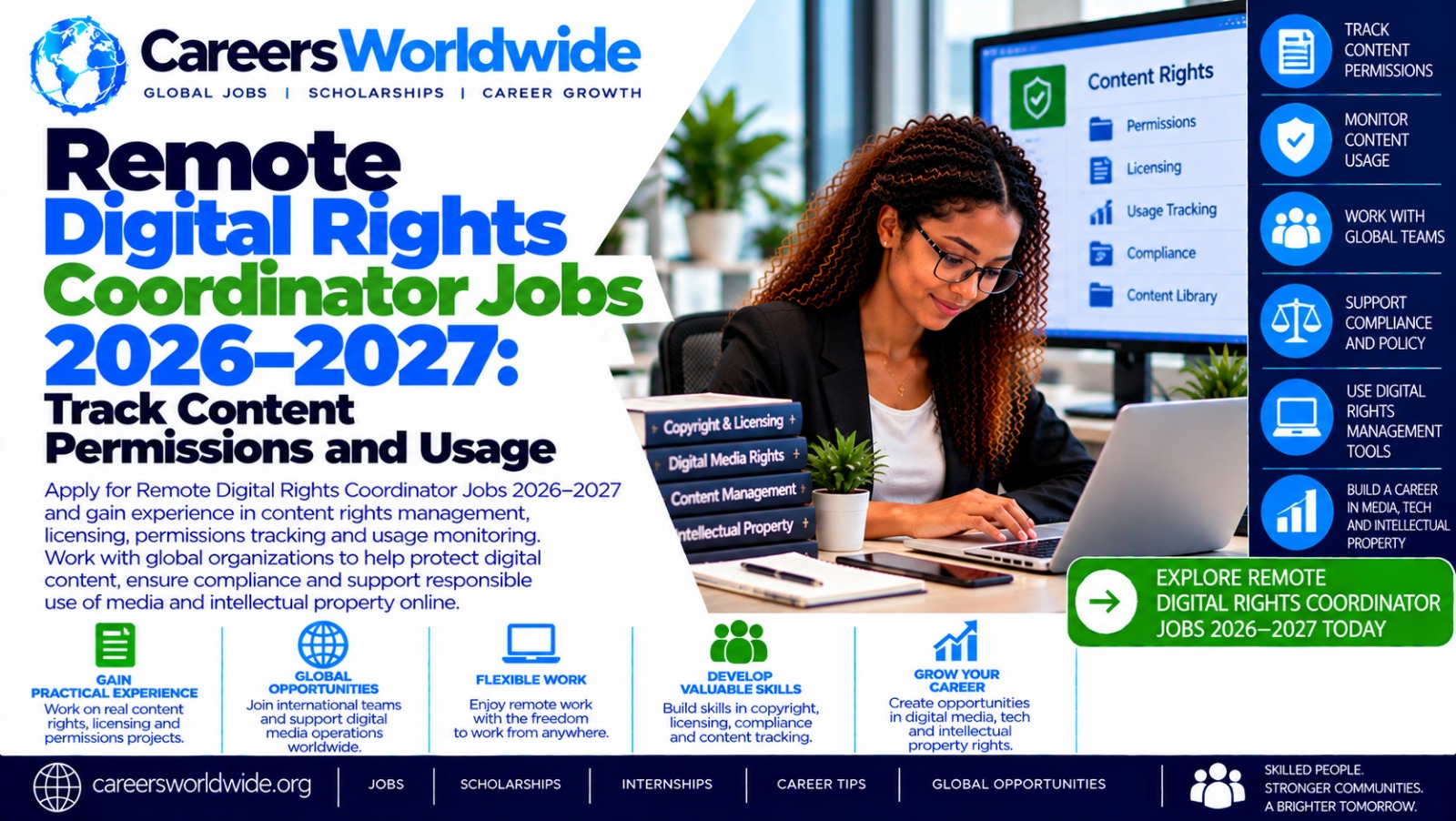

Excerpt: Remote Digital Rights Coordinator jobs in 2026–2027 offer opportunities for professionals who want to help organisations protect intellectual property, manage content permissions, track licensing agreements, and ensure digital media is used correctly. From social media videos and website images to music, photographs, and branded content, digital rights coordinators help businesses document ownership, secure approvals, and reduce copyright risks. This practical career guide explains the responsibilities, essential skills, qualifications, remote-work options, application process, and official resources to help you prepare for opportunities in digital content rights management.
Introduction: What Are Remote Digital Rights Coordinator Jobs?
Digital content is published across websites, social media platforms, streaming services, online publications, digital libraries, and marketing channels every day. However, having access to a photograph, video, song, article, or graphic does not automatically mean an organisation has permission to use it.
This is where a Digital Rights Coordinator can make a difference.
A Digital Rights Coordinator helps organisations track the permissions, licences, restrictions, and approvals associated with digital content. The role connects content production with rights management, documentation, compliance, and communication. Depending on the employer, it may sit within a legal department, publishing team, marketing operation, media organisation, music company, or content production business.
For 2026–2027, job seekers can explore several related titles, including Digital Rights Coordinator, Content Rights Coordinator, Rights and Clearances Coordinator, Licensing Coordinator, Digital Asset Coordinator, and Content Permissions Specialist.
These titles overlap, but they are not always interchangeable. Some positions focus on copyright documentation and licensing, while others concentrate on creator permissions, digital asset management, music rights, or social media publishing.
Important: “Remote Digital Rights Coordinator Jobs 2026–2027” describes a career category, not a single universal vacancy or recruitment programme. Employers set their own eligibility requirements, salaries, application deadlines, and remote-work policies. Applicants should verify each opening on the employer’s official careers website before applying.
1. What Does a Digital Rights Coordinator Do?
A Digital Rights Coordinator helps ensure that content is used according to the permissions and conditions established by its owners, creators, licensors, or authorised representatives.
The exact responsibilities depend on the organisation and the type of content it manages.
Track content permissions
Coordinators maintain records showing whether a photograph, video, illustration, article, recording, or other asset can be used. They may record the rights holder, permission date, approved platform, permitted territory, duration, and any restrictions.
For example, a creator might permit a company to share a video on Instagram but not to use it in a paid advertising campaign. The coordinator documents that distinction so the marketing team does not accidentally exceed the permission granted.
Manage licensing agreements
Some content requires a licence before publication. Coordinators help collect agreements, confirm approval status, organise supporting documents, and alert colleagues when a licence is due to expire.
Depending on the role, they may also communicate with licensing agencies, photographers, publishers, production companies, music rights holders, and external contributors.
Maintain digital rights databases
An organisation may manage thousands of digital assets. Without an organised tracking system, employees can struggle to determine which materials are approved for publication.
A coordinator may use spreadsheets, digital asset management systems, content management platforms, or specialist rights-management software to maintain accurate records.
Support copyright compliance
Digital Rights Coordinators help teams follow internal procedures and applicable copyright requirements. They may flag missing permissions, unclear ownership, expired licences, attribution requirements, or restrictions on editing and redistribution.
They generally do not replace qualified legal counsel. Complex ownership disputes, legal interpretations, and litigation matters may need to be referred to lawyers or designated compliance professionals.
Coordinate with content teams
The role involves regular communication with editors, designers, marketers, producers, social media managers, legal teams, and external creators.
The objective is straightforward: help teams publish appropriate content efficiently while keeping permission records complete and accessible.
2. Where Can You Find Remote Digital Rights Coordinator Jobs?
Remote opportunities can appear in several industries. However, the word remote does not necessarily mean applicants can work from any country.
Industries to explore

Digital media and publishing
Publishers, online magazines, news organisations, and digital libraries need accurate records for photographs, illustrations, articles, archival materials, and syndicated content.

Music and entertainment
Music companies, video producers, broadcasters, and streaming-related businesses may need support with sound recordings, compositions, performance rights, video clips, and usage restrictions.

Marketing and social media
Brands and agencies need to document permissions for user-generated content, influencer collaborations, promotional photographs, videos, and advertising materials.

Technology and digital asset management
Software companies, online platforms, archives, and businesses with large content libraries may recruit professionals to organise metadata, ownership records, permissions, and asset usage histories.
Related job opportunities to monitor
Searches for adjacent roles can uncover opportunities that are not advertised under the exact title “Digital Rights Coordinator.”
For example, a recent 2026 listing for a remote Content Rights & Operations Coordinator at PlayOn! Sports described work involving creator permissions, user-generated content, rights documentation, audio checks, metadata tagging, and brand-protection processes. Its published eligibility conditions should be checked directly before applying.
WorkPivot
+1
Other useful titles include:
- Rights and Clearances Coordinator
- Content Licensing Assistant
- Copyright and Permissions Assistant
- Digital Asset Management Coordinator
- Media Rights Operations Associate
- Music Rights Administration Coordinator
- Content Compliance Specialist
- Intellectual Property Operations Assistant
Searching these alternatives can help applicants discover entry-level, contract, part-time, and experienced positions across different industries.
3. Qualifications and Skills Required for 2026–2027
There is no single qualification required for every Digital Rights Coordinator position. Employers may prioritise practical experience, administrative accuracy, copyright knowledge, communications skills, or familiarity with specific content management systems.
Educational background
A degree or diploma in one of the following fields may be useful:
- Media and communications
- Journalism and digital publishing
- Law or intellectual property studies
- Information management and library science
- Marketing and public relations
- Business administration
- Digital media production
Some employers accept equivalent professional experience instead of a specific degree. Entry-level applicants should read each job description carefully rather than assuming that a law degree is compulsory.
Technical skills
Strong candidates can demonstrate competence in several practical areas.
1. Spreadsheet management: Excel or Google Sheets can help track content ownership, licence dates, usage restrictions, and approval status.
2. Digital asset management: Familiarity with asset libraries and content management systems helps professionals locate files, review metadata, and maintain organised records.
3. Copyright and licensing fundamentals: Applicants should understand that copyright ownership, permission to use a work, and ownership of a physical or digital copy are different concepts.
4. Metadata and documentation: Accurate file names, source links, rights-holder details, dates, and approval records make content easier to audit.
5. Written communication: Coordinators frequently request permissions, clarify licence conditions, and follow up with internal teams or external rights holders.
6. Attention to detail: A small mistake involving a licence expiry date, advertising restriction, or approved territory can result in content being used outside its authorised scope.
Soft skills that employers value
Remote work requires more than technical knowledge. Employers may also look for independent problem-solving, time management, professional communication, confidentiality, and the ability to prioritise urgent requests.
Because coordinators work with multiple departments, they need to explain restrictions clearly without unnecessarily slowing down legitimate publishing work.
Can beginners apply?
Yes, where the employer accepts junior applicants or provides training. Relevant experience can come from assisting a publisher, managing social media content, organising photographs, supporting a production team, maintaining business records, or working in an administrative role.
A beginner can also build a demonstration project showing how permissions are recorded and reviewed. Use fictional assets and clearly label the exercise as a sample rather than presenting it as professional client work.
4. Practical Guidance: Build a Job-Ready Rights-Tracking Portfolio
A small portfolio can help employers understand how you would approach real content operations.
Create a sample content permissions tracker with the following fields:
| Field | Information to record |
|---|---|
| Asset ID | Unique identifier for the file |
| Content description | Photograph, video, article, audio, or graphic |
| Source | Original creator or source URL |
| Rights holder | Person or organisation identified as the owner |
| Permission evidence | Link or reference to written approval |
| Approved usage | Website, organic social media, advertising, or another authorised channel |
| Territory | Geographic limits, if specified |
| Licence period | Start date and expiry date, if applicable |
| Restrictions | Attribution, editing, exclusivity, or other conditions |
| Status | Pending, approved, restricted, expired, or escalated |
For a demonstration, populate the tracker with fictional records. Add conditional formatting to highlight upcoming expiry dates and missing approvals.
Then create a simple standard operating procedure explaining what happens when a new asset arrives, who verifies the permission, how evidence is stored, and who authorises publication.
This exercise demonstrates that you understand both the administrative and operational sides of rights management.
Example workflow
Imagine a marketing team wants to publish a photograph submitted by a customer.
- Record the photograph’s source and creator details.
- Identify who owns the relevant rights and whether other permissions may be necessary.
- Request approval specifying the intended use.
- Save the written approval and any associated licence terms.
- Check restrictions covering platforms, advertising, duration, territory, editing, and attribution.
- Update the rights tracker and communicate the approval status.
- Flag any ambiguity for review before publication.
- Recheck the record if the intended use changes.
A social media message, a general credit line, or a photograph being publicly available should not automatically be treated as sufficient permission for every proposed use.
5. Summary Table: Remote Digital Rights Coordinator Jobs
The following table summarises common role types. These are illustrative career categories, not a list of guaranteed vacancies.
| Role type | Typical responsibilities | Useful background | Experience level |
|---|---|---|---|
| Junior Rights Assistant | Organise permissions and supporting files | Administration, media studies | Entry level |
| Digital Rights Coordinator | Track usage terms and approvals | Content operations, copyright basics | Junior to mid-level |
| Rights and Clearances Coordinator | Secure third-party permissions for productions | Research, media production | Junior to experienced |
| Music Rights Coordinator | Maintain recording and composition rights data | Music administration, metadata | Varies |
| Digital Asset Coordinator | Organise content libraries and metadata | Information management, CMS tools | Entry to mid-level |
| Rights Operations Specialist | Manage workflows, audits, and exceptions | Rights systems, reporting | Mid-level |
| Licensing Coordinator | Track licences and coordinate with rights holders | Contracts administration, communications | Varies |
Salary expectations
There is no universal salary for this job category. Compensation depends on the country, employer, seniority, workload, employment classification, and whether the position is permanent, part-time, or contract-based.
Before accepting an offer, confirm:
- The advertised salary and currency.
- Whether payment is hourly, monthly, or annual.
- Whether the role is an employee position or independent contract.
- Whether benefits, paid leave, or equipment allowances are provided.
- Which country’s tax and employment rules apply.
- Whether international applicants can legally and practically be hired.
Avoid relying on salary estimates from unrelated coordinator positions. The most reliable figure is the compensation stated in the specific employer’s verified vacancy.
6. How to Apply for Remote Digital Rights Coordinator Jobs
A focused application is usually more effective than sending the same CV to every vacancy.
Step 1: Search using relevant job titles
Look for Digital Rights Coordinator, Rights and Clearances Coordinator, Content Rights Operations, Copyright Permissions Assistant, and Licensing Coordinator. Apply appropriate filters for remote work and employment type.
Step 2: Read the eligibility requirements
Confirm the accepted countries, time-zone expectations, language requirements, work authorisation rules, required experience, and closing date. A vacancy labelled remote may be restricted to a particular country.
Step 3: Tailor your CV
Highlight rights tracking, records management, spreadsheet skills, content publishing, licensing support, stakeholder communication, and relevant compliance experience. Use measurable achievements where you can substantiate them.
Step 4: Prepare a relevant portfolio
Include a fictional permissions tracker, a sample rights-review checklist, or a workflow diagram. Do not share confidential documents, private customer information, or copyrighted material without authorisation.
Step 5: Apply through the verified recruitment channel
Follow the instructions on the employer’s official careers page. Submit requested documents, complete any application questions, and retain confirmation of your submission.
Step 6: Track your applications
Record the employer, vacancy title, application date, contact details published by the employer, deadline, and follow-up date. Keep separate notes for interviews and assessments.
Writing a strong application
Your CV should show evidence of accuracy, organisation, and sound judgement. Instead of writing “responsible for managing content,” consider a truthful, specific statement such as:
“Maintained a structured digital asset register, recorded approval status and usage restrictions, and flagged incomplete documentation before publication.”
Only use this wording if it accurately describes your experience. If you have not worked in a formal rights-management role, describe related administrative or content work honestly.
In a cover letter, explain why rights management interests you, which relevant skills you offer, and how you would help the employer maintain reliable records and efficient approval processes.
7. Official Application Resources for 2026–2027
Use the following resources to research vacancies, understand copyright fundamentals, and identify legitimate application channels. These are career and educational resources, not a guarantee that a particular employer is hiring for this exact position.
1. Digital Rights Job Board
Digital rights, internet freedom, and public-interest technology vacancies.
Browse opportunities by organisation, location, and role, then follow the relevant employer’s application instructions.
Visit the Digital Rights Job Board
2. U.S. Copyright Office — Careers
Official public-sector career information and copyright-related opportunities.
Review current openings and the application instructions for positions advertised by the Copyright Office.
Visit Copyright Office Careers
3. U.S. Copyright Office — Copyright Basics
Educational material for understanding copyright and protected works.
Learn about copyright ownership, the rights of copyright holders, and common categories of protected content. Remember that U.S. rules do not automatically apply in every country.
U.S. Copyright Office
+1
4. U.S. Copyright Office — Obtaining Permission
Practical guidance on seeking permission to use copyrighted works.
This resource explains how permission and licensing can help establish an authorised basis for using someone else’s work.
U.S. Copyright Office
+1
5. Zimbabwe Government Employment Services Portal (ERIS)
A government employment resource for Zimbabwean job seekers.
Applicants based in Zimbabwe can explore registration and employment-matching information. Check the portal’s current requirements and whether a relevant vacancy is available.
Visit the ERIS Employment Portal
How to identify genuine vacancies
Start with the employer’s own careers website whenever possible. A third-party job board can help you discover a position, but verify the vacancy, location restrictions, and closing date independently.
Be cautious of offers promising unusually high earnings for minimal work, recruiters using unverifiable email addresses, and requests for upfront recruitment fees. The U.S. Federal Trade Commission advises job seekers not to pay to obtain employment and warns about fake-check and work-from-home scams.
Consumer Advice
+1
For international applicants, verify whether the employer hires in your country directly, through an authorised employment partner, or only within a specified region.
8. Frequently Asked Questions (FAQ)
1. What is a Remote Digital Rights Coordinator?
A Remote Digital Rights Coordinator manages records and processes relating to digital content permissions, licensing, ownership, usage restrictions, and approvals. The position can involve photographs, videos, articles, music, graphics, and user-generated content.
2. Are Digital Rights Coordinator jobs available in 2026–2027?
Digital rights and content operations are established job categories, and relevant vacancies may be advertised during 2026–2027. Availability changes as employers open, fill, or close positions. Use current job boards and official company career pages to verify live opportunities.
3. Can I apply without a law degree?
Yes, if the vacancy does not require one. Some positions focus on documentation, administration, metadata, and workflow coordination rather than legal practice. A law degree may be advantageous for particular compliance-heavy roles, but requirements vary.
4. Can beginners work remotely in digital rights management?
Some junior positions may be suitable for beginners, especially those involving data entry, permissions administration, content operations, or digital asset organisation. A sample rights tracker and evidence of strong administrative skills can help demonstrate readiness.
5. Do these jobs allow applicants from Africa?
Some employers recruit internationally, but others restrict remote positions to specific countries. Applicants from Zimbabwe and elsewhere in Africa should check residency rules, work authorisation, time-zone requirements, payroll arrangements, and payment methods before applying.
6. What tools should I learn?
Start with Excel or Google Sheets, shared document management, file organisation, and content management fundamentals. Depending on the industry, familiarity with digital asset management platforms, licensing databases, metadata standards, and project management tools can also be helpful.
7. Is experience in copyright compulsory?
Not every vacancy requires formal copyright experience. However, understanding permissions, ownership, attribution, licence restrictions, and recordkeeping is valuable. Candidates should be ready to explain how they would identify missing approvals and escalate uncertain cases.
8. How much can a Digital Rights Coordinator earn?
Pay varies by country, seniority, employer, contract type, and specialist knowledge. There is no single reliable salary that applies to every remote position. Check the advertised compensation and employment terms for each verified vacancy.
9. Are application fees required?
Legitimate recruitment processes should not require you to pay a recruiter to secure a job. Be especially wary of requests for deposits, equipment purchases through an unfamiliar supplier, gift cards, cryptocurrency, or payments to release an offer.
10. Where should I submit my application?
Apply through the employer’s official recruitment portal or the application link confirmed on its official website. A general career article cannot accept applications on behalf of employers or guarantee selection.
9. A Simple 30-Day Preparation Plan
If you are preparing to enter the field, use the following plan to organise your efforts.
Your preparation checklist
0 of 4 complete
Week 1
Learn the fundamentals
Study copyright basics, licensing terminology, attribution, and common permission restrictions.
Week 2
Build a sample tracker
Create a fictional rights register with status labels, expiry dates, source records, and approval evidence.
Week 3
Prepare your application materials
Update your CV, draft a tailored cover letter, and organise a small portfolio of sample work.
Week 4
Apply and improve
Research verified vacancies, submit targeted applications, track responses, and practise interview scenarios.
This schedule is a suggested starting point, not a guarantee of employment within 30 days. Continue improving your skills and adapting your applications to the positions you actually find.
10. Final Summary
Remote Digital Rights Coordinator jobs offer a potential career path for people interested in digital media, copyright administration, licensing, content operations, and organised information management.
The work centres on making sure that digital assets have appropriate permissions, that restrictions are recorded accurately, and that teams can establish whether content is approved for its intended use.
To improve your prospects for 2026–2027:
- Learn the basics of copyright, licensing, and permission records.
- Develop spreadsheet, metadata, and document-management skills.
- Build a sample rights-tracking portfolio using fictional assets.
- Search for related job titles rather than relying on one exact phrase.
- Verify remote-work eligibility and salary details for each vacancy.
- Apply through official recruitment channels and avoid upfront-fee scams.
A strong application demonstrates careful recordkeeping, clear communication, sound judgement, and respect for intellectual property. These practical abilities can help candidates present themselves credibly for entry-level and experienced content rights positions.
Disclaimer
This article is for general career information and educational purposes only. It does not represent a specific employer’s recruitment announcement, guarantee that vacancies are available, promise employment, or provide legal advice. Job titles, qualifications, salaries, locations, eligibility criteria, and application deadlines vary by employer and may change without notice.
The linked resources provide information about careers and copyright, but they do not endorse every vacancy advertised elsewhere. Copyright rules differ by jurisdiction, and applicants should consult appropriate legal or professional guidance when necessary. Always verify vacancies through official employer channels before sharing personal information or accepting an offer.
SEO Keywords
Remote Digital Rights Coordinator Jobs 2026, Remote Digital Rights Coordinator Jobs 2027, Digital Rights Coordinator careers, remote copyright coordinator jobs, content permissions jobs, digital content rights management, remote licensing coordinator jobs, rights and clearances coordinator jobs, content rights operations jobs, digital asset management careers, copyright administration jobs, remote media rights jobs, content licensing assistant jobs, digital copyright compliance careers, remote media coordinator jobs, work from home digital rights jobs, digital content permissions specialist, remote intellectual property assistant jobs, music rights coordinator careers, remote publishing rights jobs, user generated content rights management, digital rights management skills, copyright licensing careers 2026, international remote coordinator jobs, remote content compliance jobs, digital rights job application tips, entry level digital rights jobs, remote rights management opportunities, digital permissions tracking, digital rights jobs for international applicants,
ALSO CHECK: Remote Airline Ticketing Specialist Jobs 2026–2027: Manage Reservations and Ticket ChangesOctober 16, 2026
Remote Travel Risk Support Jobs 2026–2027: Help Organizations Manage Travel DisruptionsOctober 16, 2026
Remote Corporate Travel Coordinator Jobs 2026–2027: Manage Business Travel ArrangementsOctober 16, 2026