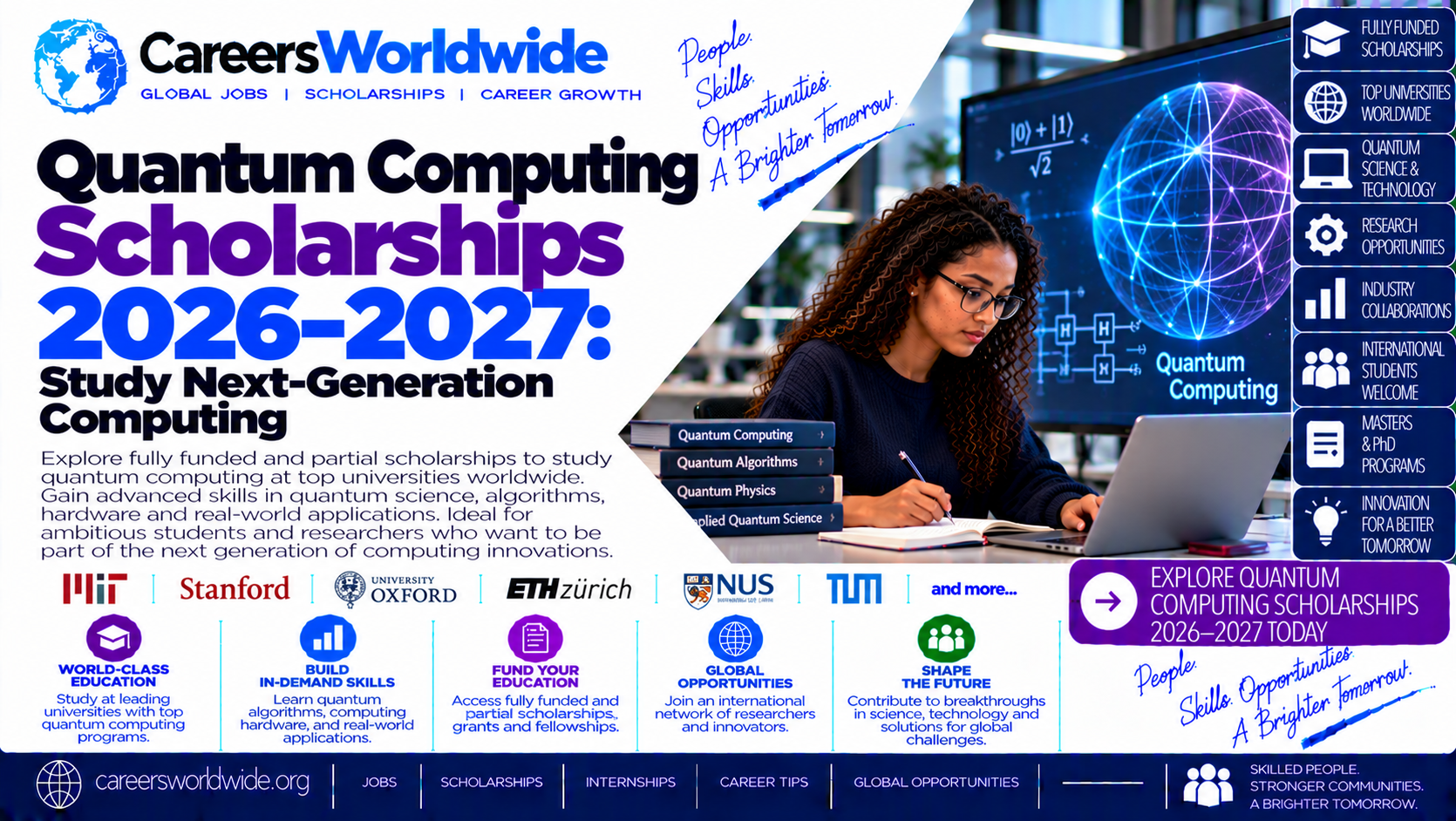

Excerpt: Discover quantum computing scholarships for 2026–2027 and explore funding opportunities for undergraduate study, master’s degrees, PhD research, and quantum information science. Learn about eligibility requirements, universities, research fellowships, application documents, and practical strategies for securing financial support to study next-generation computing, quantum algorithms, and advanced technologies.
Quantum computing is emerging as an important field at the intersection of computer science, mathematics, physics, and engineering. Universities and research institutions are training students to develop quantum algorithms, design quantum devices, investigate new materials, and explore computing methods that could transform selected scientific and industrial applications.
For students interested in this rapidly developing area, scholarships and research fellowships can help reduce the financial barriers to advanced study. Funding may come from universities, government research agencies, specialist quantum research centres, and industry-supported doctoral programs.
The 2026–2027 academic cycle is particularly relevant for students planning postgraduate research in quantum information science, quantum engineering, quantum algorithms, and related disciplines. Some opportunities are designed for domestic students, while others may accept international applicants. Funding arrangements can range from tuition discounts to fully funded doctoral positions with living stipends.
However, quantum computing funding is not always advertised under the exact term “quantum computing scholarship.” Students should also search for quantum information science, quantum technology, computational physics, quantum engineering, and theoretical computer science awards.
This CareersWorldwide guide explains where to look, what eligibility criteria to expect, how to prepare a strong application, and which official resources to check before applying.
1. What Are Quantum Computing Scholarships?
Quantum computing scholarships provide financial support to students studying subjects related to quantum computation, quantum information science, and associated technologies.
Unlike conventional computing, which represents information using classical bits, quantum computing uses quantum states to encode and process information. Quantum systems can exhibit properties such as superposition and entanglement, which enable computational approaches that differ fundamentally from classical methods.
Quantum computers are not faster for every task, and many proposed applications remain active research areas. Nevertheless, researchers are investigating their potential in areas such as quantum simulation, cryptography, optimization, materials science, and chemistry.
Scholarships in this field can support students pursuing:
- Quantum computing and quantum algorithms.
- Quantum information science.
- Quantum physics and quantum optics.
- Quantum engineering and device development.
- Computer science and computational mathematics.
- Quantum communication and cryptography.
- Semiconductor physics and advanced materials.
- Quantum software and hardware systems.
Funding may cover tuition fees, living expenses, research costs, conference attendance, or industry placements, depending on the program.
Some awards are merit-based, while others are attached to a specific research project or university admission offer. A scholarship advertised as “fully funded” should be checked carefully to establish exactly which expenses are covered.
2. Why Study Quantum Computing in 2026–2027?
Quantum computing is a multidisciplinary field, so students can enter it through several academic pathways.
Growing research activity
Universities, government agencies, and technology companies are investing in research related to quantum hardware, algorithms, error correction, and quantum information processing.
The U.S. National Science Foundation’s Quantum Information Science program supports theoretical and experimental research involving quantum computing, simulation, sensing, networking, and related technologies. Its official funding page provides an overview of eligible research areas and program requirements.
NSF – U.S. National Science Foundation
Opportunities across multiple disciplines
You do not necessarily need a bachelor’s degree titled “Quantum Computing” to enter the field.
Students with backgrounds in physics, mathematics, computer science, electrical engineering, materials science, and related disciplines may be eligible for appropriate programs.
Access to specialist research facilities
Some doctoral scholarships provide opportunities to work with quantum laboratories, computing systems, research centres, and interdisciplinary academic teams.
The quality of supervision, research facilities, and project fit can be as important as the scholarship amount.
Industry and research experience
Certain funded programs include industry placements, collaborative projects, or professional development. These experiences can help students understand how research connects to practical engineering and technology challenges.
International academic collaboration
Quantum research is conducted across universities and research institutions in many countries. Students may find opportunities to study abroad, participate in collaborative research, or pursue doctoral projects involving international partners.
However, scholarship availability does not automatically mean a program is open to every nationality. Eligibility must be confirmed for each award.
3. Quantum Computing Scholarships and Funding Opportunities to Investigate
The following programs and official resources are relevant to the 2026–2027 search. Their eligibility, funding, and deadlines differ significantly.

1. Macquarie University — Quantum Computing Scholarship
Deadline passed
Macquarie University has advertised a PhD scholarship associated with the ARC Training Centre for Future Leaders in Quantum Computing (FLiQC). The project scope includes quantum devices, algorithms, and architectures.
The published 2026 stipend rate is A$42,754 per year for up to four years. The listed application period ran from 26 August to 8 October 2026, so this particular round has closed as of 10 October 2026. The listing identifies domestic and international eligibility, subject to the program’s requirements.
Macquarie University
Check the official scholarship page
Prospective applicants should check for a new round or related FLiQC opportunities rather than assume applications remain open.

2. U.S. National Science Foundation Graduate Research Fellowship Program
2027 cycle: upcoming deadlines
The NSF Graduate Research Fellowship Program supports eligible students pursuing research-based master’s or doctoral degrees in supported STEM fields at accredited U.S. institutions.
The current FY2027 solicitation provides three years of support within a five-year fellowship period, including a US$37,000 annual stipend and a US$16,000 cost-of-education allowance for each supported year. The published application deadlines for 2026 fall between 19 and 23 October, depending on the field.
NSF – U.S. National Science Foundation
+1
Important eligibility restriction: Applicants must be U.S. citizens, nationals, or permanent residents. This program is therefore not an option for international students who do not meet those conditions.
Read the official NSF fellowship details

3. U.S. Department of Energy Computational Science Graduate Fellowship
This fellowship supports doctoral students using computational science and high-performance computing to advance research in areas including quantum science and engineering, mathematics, physics, and materials science.
The DOE announced its 2026–2027 incoming fellowship class in June 2026. The program is worth investigating for students whose research combines computational methods with quantum technologies, although it is not exclusively a quantum computing scholarship. Check the current program rules for eligibility and the next application cycle.
Department of Energy
Visit the DOE Office of Science
These opportunities illustrate different funding routes: a specialist university PhD scholarship, a broad STEM graduate fellowship, and a computational science fellowship. They should not be treated as interchangeable awards.
Students should also search university graduate funding databases for quantum information science, quantum engineering, and computational physics projects. Many opportunities are attached to individual supervisors or research groups rather than a general scholarship program.
4. Which Universities and Research Centres Should You Explore?
Quantum computing scholarships are often connected to a specific research group, laboratory, or doctoral project. Choosing institutions based on their research strengths can help you identify more relevant funding opportunities.

Macquarie University — Australia
Investigate research in quantum computing devices, algorithms, architectures, and quantum technology. Its FLiQC scholarship page is a useful starting point for checking future funding rounds and related projects.
University research and scholarships

University of Waterloo — Canada
The Institute for Quantum Computing brings together researchers working across quantum information, physics, mathematics, and engineering. Explore graduate admission, supervisor funding, and university awards.
Institute for Quantum Computing

University of Oxford — United Kingdom
Explore research in quantum technologies, theoretical physics, quantum information, and related disciplines. Funding may be linked to a particular graduate course, research group, or external award.
Oxford graduate admissions and funding

University of Chicago — United States
Investigate graduate programs and research opportunities connected to quantum information science and the wider quantum research ecosystem. Check each department’s admission and funding arrangements.
These institutions are research destinations to investigate, not a claim that each currently has an open, dedicated quantum computing scholarship for 2026–2027. A department may offer funding through a general graduate assistantship, research project, or institutional award instead.
When comparing universities, consider supervisor expertise, access to research equipment, coursework, funding duration, living costs, and the availability of relevant projects.
5. Who Is Eligible for Quantum Computing Scholarships?
Eligibility depends on the academic level and funding program.
Undergraduate students
Applicants may need strong grades in mathematics, physics, computer science, or related subjects. Some awards support general STEM study rather than quantum computing specifically.
Master’s students
Programs may seek a relevant bachelor’s degree and evidence of preparation in linear algebra, probability, programming, physics, or algorithms. Some quantum technology master’s degrees accept applicants from multiple disciplines if they have the required prerequisites.
PhD applicants
Doctoral scholarships often require a strong academic record, research experience, and a clear fit with a supervisor’s project. Applicants may also need a research proposal, references, and evidence of relevant technical preparation.
International applicants
International eligibility varies. Some universities welcome applicants worldwide, while government fellowships may be restricted to citizens or permanent residents of a particular country.
Before applying, verify:
- Accepted nationalities and residency requirements.
- Required degree and academic grades.
- English-language proficiency requirements.
- Whether admission must be secured before applying for funding.
- Whether the scholarship covers international tuition.
- Whether a living stipend is included.
- Whether visa and relocation expenses are covered.
- Whether applicants must contact a supervisor before submission.
Practical guidance: Do not assume that a scholarship is fully funded simply because it offers a stipend. Confirm whether tuition, health insurance, research expenses, and living costs are covered separately.
6. Academic Subjects That Can Lead to Quantum Computing
Quantum computing is multidisciplinary, so your previous degree does not always need to carry the same title as your intended specialization.
| Academic background | Potential research direction |
|---|---|
| Computer science | Quantum algorithms and software |
| Mathematics | Quantum information theory and algorithms |
| Physics | Quantum systems, devices, and quantum mechanics |
| Electrical engineering | Quantum hardware and control systems |
| Materials science | Quantum materials and device fabrication |
| Computer engineering | Quantum-classical architectures and systems |
| Statistics | Quantum information and computational methods |
| Chemistry | Quantum simulation and molecular modelling |
For students transitioning from a conventional computing degree, linear algebra, probability, complex numbers, and introductory quantum mechanics are useful areas to strengthen.
For students coming from physics, programming, algorithms, and computational methods may be important preparation.
A competitive application explains how your previous studies connect to the proposed research rather than simply stating that quantum computing is an exciting field.
7. How to Prepare a Strong Scholarship Application
Scholarship committees generally need evidence that applicants can succeed in the proposed program and make meaningful contributions to research.
Academic transcripts
Prepare official or certified transcripts from your previous institutions, following the scholarship’s instructions. Check whether translations are required.
Curriculum vitae
Include relevant coursework, research projects, programming experience, academic achievements, publications, internships, and technical skills.
Statement of purpose
Explain why you want to study quantum computing, which problems interest you, and how the program fits your long-term goals.
Avoid using the same generic statement for every university. Mention relevant research groups, courses, or project themes where appropriate.
Research proposal
Some PhD scholarships require a proposal describing the research question, background, methods, potential contribution, and feasibility.
Your proposal should be specific enough to demonstrate preparation while remaining aligned with the supervisor’s research area.
Recommendation letters
Request references from academic staff or research supervisors who can discuss your abilities, research potential, and academic preparation.
Give referees sufficient time and provide them with the scholarship requirements and your latest CV.
Evidence of technical preparation
Depending on the program, useful evidence can include programming projects, mathematical coursework, research experience, or work with quantum computing software and simulators.
Do not claim quantum hardware experience if you have only used a simulator. Explain accurately what you have built, tested, or studied.
8. A Practical Portfolio for Aspiring Quantum Computing Students
If you lack direct quantum research experience, a small portfolio can demonstrate your initiative and technical readiness.
Consider these projects:
Project 1: Implement a simple quantum circuit.
Use an educational quantum computing framework to create a circuit with a few qubits. Explain the gates, measurement process, and resulting probabilities.
Project 2: Explore quantum superposition and entanglement.
Create a simple demonstration that explains the difference between a classical probability distribution and a quantum state. Describe what the simulation demonstrates and its limitations.
Project 3: Compare a classical and quantum algorithm.
Study a suitable introductory example, such as the Deutsch–Jozsa algorithm or Grover’s search algorithm. Explain the assumptions and why the quantum approach is interesting, without claiming a general speed advantage for every practical problem.
Project 4: Reproduce a published result.
Select a manageable research paper and reproduce a small simulation or calculation. Document the software, parameters, results, and any differences from the published work.
Project 5: Write a research summary.
Choose a quantum computing paper and explain its research question, methods, main results, limitations, and possible next steps in clear language.
For every project, include documentation, code where appropriate, and an explanation of what you learned. Use open-source tools and publicly available materials under their applicable terms.
A portfolio does not replace formal eligibility requirements, but it can strengthen your application and help you discuss your research interests during interviews.
9. A 30-Day Scholarship Preparation Plan
Days
1–7
Week 1: Identify your research direction
Decide whether you are interested in quantum software, algorithms, hardware, materials, or theoretical research. Review course prerequisites and funding eligibility.
Days
8–14
Week 2: Research universities and scholarships
Create a spreadsheet listing programs, deadlines, accepted nationalities, tuition costs, stipend details, and required documents.
Days
15–21
Week 3: Prepare application materials
Update your CV, draft your statement of purpose, identify potential referees, and develop a small technical or research portfolio.
Days
22–30
Week 4: Finalize and submit suitable applications
Contact supervisors where appropriate, verify deadlines and eligibility, complete required forms, and submit applications with enough time to resolve technical issues.
For scholarships with deadlines that have already passed, use this period to prepare for the next cycle rather than submitting late materials. Some awards accept applications only once per year.
10. Where to Find Official Quantum Computing Scholarships
The following resources can help you discover scholarships, research fellowships, and funded graduate programs.

National Science Foundation (NSF)
Explore graduate fellowships and research funding connected to quantum information science, computer science, mathematics, physics, and engineering. Check the nationality restrictions of each program.
NSF – U.S. National Science Foundation

U.S. Department of Energy
Investigate computational science fellowships and other research training opportunities involving high-performance computing, physics, and quantum science.
Department of Energy

Macquarie University
Check the quantum computing PhD scholarship page for the next funding round, eligibility requirements, and related research projects. The published October 2026 deadline for the listed award has passed.
Macquarie University

University of Waterloo
Explore quantum research, graduate study, and department-specific financial support. Confirm the available funding for your intended degree.
Institute for Quantum Computing

University of Oxford
Search graduate programs and funding options in physics, computer science, engineering, and quantum technologies.
For additional opportunities, search official university funding databases using these terms:
- Quantum information science PhD scholarship.
- Quantum computing graduate fellowship.
- Quantum engineering doctoral studentship.
- Quantum technology research scholarship.
- Quantum algorithms PhD funding.
- Computational physics graduate scholarship.
- Fully funded quantum computing PhD.
A doctoral position may provide funding through a research assistantship or project grant rather than a scholarship carrying a specific quantum computing title. Read the full offer to understand the financial arrangements.
11. How to Apply for Quantum Computing Scholarships
Follow this process to organize your applications.
Step 1: Select your academic level. Determine whether you are applying for an undergraduate degree, master’s program, or PhD.
Step 2: Identify suitable programs. Look for courses and research groups that match your academic background and research interests.
Step 3: Confirm eligibility. Check citizenship, residency, academic grades, prerequisites, language requirements, and application deadlines.
Step 4: Contact a potential supervisor. For research degrees, read the supervisor’s publications and send a concise email explaining your background, research interests, and why the project is relevant to you. Do this when the university recommends or permits supervisor contact.
Step 5: Prepare your documents. Gather transcripts, certificates, references, your CV, statement of purpose, and research proposal if required.
Step 6: Complete the scholarship application. Some universities automatically consider admitted students for funding. Others require a separate scholarship application. Do not assume one application covers both.
Step 7: Submit before the deadline. Check the time zone, document requirements, and referee submission deadlines. Keep confirmation emails and copies of submitted materials.
Step 8: Prepare for interviews. Be ready to discuss your academic background, relevant mathematics or programming knowledge, research interests, and reasons for selecting the program.
12. Quantum Computing Scholarships 2026–2027: Summary Table
| Scholarship or resource | Funding focus | Important consideration |
|---|---|---|
| Macquarie University Quantum Computing Scholarship | Quantum computing PhD research | Published deadline was 8 October 2026; check for future rounds |
| NSF Graduate Research Fellowship | Research-based STEM graduate degrees | U.S. citizenship, nationality, or permanent residency required |
| DOE Computational Science Graduate Fellowship | Computational science, including quantum-related research | Check the current fellowship eligibility and cycle |
| University of Waterloo | Quantum research and graduate study | Investigate department and supervisor funding |
| University of Oxford | Graduate study and research in related disciplines | Funding and international eligibility vary |
| U.S. National Science Foundation QIS program | Quantum information science research funding | Primarily supports research proposals rather than individual student scholarship applications |
Funding amounts, application dates, and award conditions can change. The table identifies relevant pathways to investigate; it does not mean all opportunities are open for new applications on the publication date.
13. Frequently Asked Questions (FAQs)
1. Are quantum computing scholarships available for 2026–2027?
Yes, quantum-related scholarships and research fellowships exist, although availability depends on the university, country, and academic cycle. Some published deadlines have already passed, so students should check official pages for remaining opportunities and upcoming rounds.
2. Can international students apply for quantum computing scholarships?
Some university scholarships accept international applicants, while others restrict eligibility to citizens or permanent residents of particular countries. Read the eligibility rules before applying. The NSF Graduate Research Fellowship, for example, has specific U.S. citizenship and residency requirements.
3. Can I study quantum computing without a physics degree?
Potentially. Some programs accept students from computer science, mathematics, engineering, or related disciplines. However, you may need appropriate preparation in linear algebra, probability, algorithms, and quantum mechanics.
4. Are fully funded quantum computing PhD scholarships available?
Some universities and research projects provide substantial funding that may include tuition and a living stipend. The exact coverage varies. Confirm whether fees, research expenses, insurance, and other costs are included before accepting an offer.
5. What grades do I need for a quantum computing scholarship?
Requirements differ by institution and award. Competitive research scholarships often expect strong academic performance in relevant subjects. Some also consider research experience, references, technical skills, and the quality of your proposed project.
6. Can undergraduate students receive quantum computing scholarships?
Yes, some general STEM scholarships and university financial aid programs can support undergraduate students studying relevant subjects. Dedicated quantum computing awards are often more common at the postgraduate research level, but availability varies.
7. What programming languages should I learn?
Python is a useful starting point for quantum software and simulations. Familiarity with algorithms, linear algebra, and probability is also important. Specific projects may require additional tools or programming languages.
8. Do I need research experience for a quantum computing PhD scholarship?
Not every program has the same requirements, but research experience can strengthen an application. Relevant projects, a final-year dissertation, programming work, or previous laboratory experience may help demonstrate your preparation.
9. How can I find scholarships for quantum computing in Australia or the United Kingdom?
Start with university scholarship databases, graduate admissions pages, research centre websites, and government funding resources. Search for quantum technology, quantum information, quantum engineering, and related research terms rather than relying on a single keyword.
10. When should I begin preparing for 2027 scholarship applications?
Begin as early as possible. Preparing your documents, researching supervisors, and checking funding rules several months before the expected deadline gives you more time to strengthen your application. Verify each program’s published schedule rather than assuming all scholarships share the same deadline.
14. Final Thoughts: Prepare Now for the Next Generation of Computing
Quantum computing scholarships can help students pursue advanced education in one of the most technically demanding areas of modern computing. Opportunities span quantum algorithms, information science, engineering, computational physics, and materials research.
The most effective approach is to identify a clear academic direction, select institutions with relevant research expertise, and verify funding eligibility before investing time in an application.
Students should also distinguish between scholarships that are open, opportunities that have closed, and programs that may reopen in a future cycle. This is especially important during the transition between the 2026 and 2027 academic years.
If you are serious about studying quantum computing, begin by strengthening your mathematics and programming foundations, developing a small technical portfolio, and researching suitable supervisors.
Your next step is to choose a research area, identify three to five relevant universities, and build a funding calendar with verified deadlines and eligibility requirements.
Official Application Resources
- Macquarie University Quantum Computing Scholarship
- NSF Graduate Research Fellowship Program
- NSF Graduate Student Funding
- U.S. Department of Energy Office of Science
- University of Waterloo Institute for Quantum Computing
- University of Oxford Graduate Admissions
Disclaimer
This article is intended for informational and educational purposes only. Scholarship availability, funding amounts, eligibility requirements, and deadlines may change. A university or funding agency mentioned here is not necessarily accepting applications for every relevant award at the time of publication. Verify all information on the official scholarship website before applying. Admission and scholarship selection are competitive, and no funding outcome is guaranteed.
SEO Keywords
quantum computing scholarships 2026–2027, quantum computing scholarships 2027, fully funded quantum computing PhD scholarships, quantum information science scholarships, quantum technology scholarships for international students, quantum computing scholarships for international students, quantum engineering scholarships 2026, quantum computing PhD funding, quantum information science fellowships, quantum computing graduate scholarships, quantum physics scholarships 2027, quantum algorithms PhD scholarships, quantum computing scholarships Australia, quantum computing scholarships UK, quantum computing scholarships USA, Macquarie University quantum computing scholarship, quantum research fellowships 2026–2027, computational science graduate fellowships, STEM scholarships for postgraduate students, quantum computing university funding, quantum technology doctoral scholarships, quantum computing research opportunities, how to apply for quantum computing scholarships, quantum computing scholarships eligibility, next-generation computing scholarships,
ALSO CHECK: Remote Medical Literature Reviewer Jobs 2026: Review Scientific Evidence & Clinical PublicationsOctober 9, 2026
Remote Research Grants Coordinator Jobs 2026: Support Funding Applications & Award AdministrationOctober 9, 2026
Remote No-Code Automation Specialist Jobs 2026: Automate Business Tasks Without Traditional CodingOctober 9, 2026