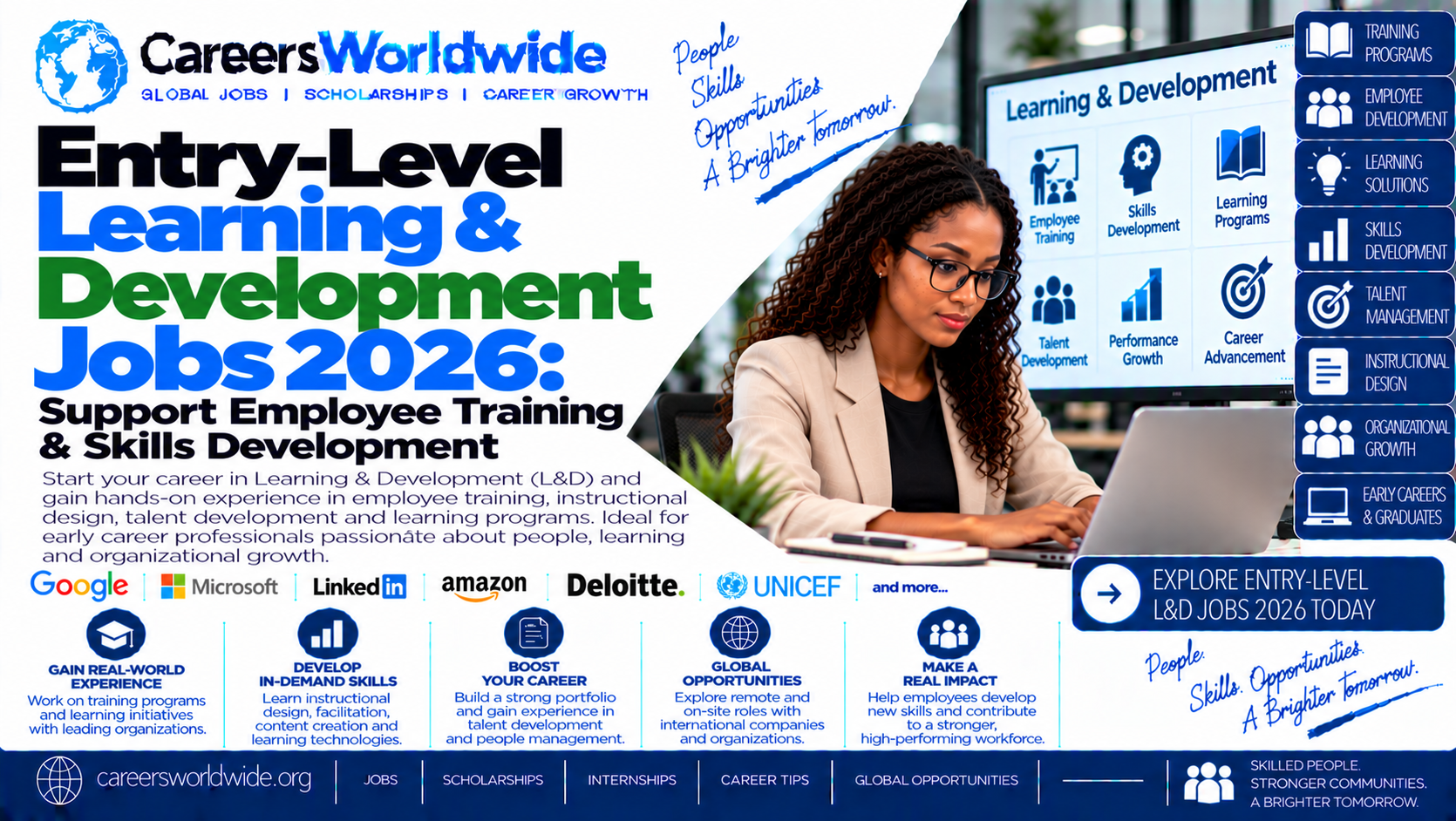

Excerpt: Entry-level Learning & Development jobs in 2026 offer an excellent starting point for graduates and early-career professionals interested in employee training, onboarding, instructional design, talent development, and workplace skills. Discover the roles to target, skills employers value, portfolio ideas, career paths, and practical ways to begin a career in L&D.
Entry-Level Learning & Development Jobs Are Creating New Career Opportunities
Organizations are increasingly focused on helping employees develop the skills needed to perform effectively today while preparing for changing responsibilities tomorrow. This has made Learning & Development (L&D) an important area within modern HR and talent-management teams.
Entry-level L&D professionals can contribute to employee onboarding, training coordination, learning-content development, virtual workshops, learning management systems, employee communications, and training evaluation.
For people starting their careers, L&D can be particularly attractive because it combines human resources, communication, technology, education, project coordination, and data analysis.
The field is also broader than simply standing in front of a classroom. The Association for Talent Development (ATD) identifies multiple talent-development career paths, including instructional design, training delivery, learning technology, coaching and development, and measurement and impact.
At the entry level, professionals may support experienced L&D managers and instructional designers while developing practical experience in how organizations identify skill gaps, create learning programs, deliver training, and evaluate results.
What Are Entry-Level Learning & Development Jobs?
Entry-level Learning & Development jobs are positions designed for professionals who are beginning a career in employee training, talent development, instructional design, organizational learning, or related HR functions.
Common job titles can include:
- Learning & Development Assistant
- Learning Coordinator
- Training Coordinator
- Training Assistant
- Talent Development Coordinator
- Learning Program Coordinator
- Employee Development Assistant
- Instructional Design Assistant
- Learning Operations Coordinator
- Training Administrator
- L&D Associate
- Talent Development Assistant
- People Development Coordinator
- Onboarding Coordinator
- Learning Experience Coordinator
The exact responsibilities vary by organization.
An L&D assistant at a large multinational organization may work primarily with a dedicated learning team, while an entry-level employee at a smaller company might handle training administration, onboarding, employee communications, and learning technology simultaneously.
ATD notes that talent-development teams can include responsibilities ranging from administrative support and curriculum design to technology enablement and classroom facilitation.
This variety makes entry-level L&D a potentially flexible career starting point.
Why Learning & Development Matters in 2026
Workplaces are changing rapidly. Employees are expected to adapt to new technologies, processes, customer expectations, regulations, and business models.
As a result, organizations need structured approaches to developing workforce capabilities.
SHRM describes L&D as a process for enhancing employee skills, knowledge, and competencies to meet both current and future organizational needs. Its scope can include onboarding, compliance training, leadership development, and continuous professional development.
SHRM’s 2026 L&D coverage also highlights the growing importance of continuous upskilling and skills development as organizations respond to changing workforce requirements.
This creates opportunities for entry-level professionals who can help make learning programs organized, accessible, engaging, and measurable.
For example, an L&D team may need someone to:
- Schedule training sessions.
- Maintain employee learning records.
- Upload courses to an LMS.
- Communicate training opportunities.
- Prepare presentation materials.
- Support virtual workshops.
- Collect participant feedback.
- Analyze completion data.
- Coordinate instructors.
- Help improve training materials.
These responsibilities can provide valuable exposure to HR and business operations.
What Does an Entry-Level L&D Professional Do?
The day-to-day work depends heavily on the organization, but several responsibilities appear frequently.
1. Training Coordination
Training coordination is one of the most accessible entry points into L&D.
A training coordinator may help organize:
- Training calendars
- Employee registrations
- Instructor schedules
- Meeting rooms
- Virtual sessions
- Training materials
- Attendance records
- Completion certificates
- Participant communications
Strong organization and attention to detail are particularly important.
2. Employee Onboarding
New employees often need training during their first days and weeks.
An entry-level L&D professional might help coordinate onboarding programs covering:
- Company policies
- Workplace culture
- Technology systems
- Compliance
- Job-specific procedures
- Security awareness
- Customer service
- Health and safety
This can give early-career professionals exposure to employee experience and HR operations.
3. Learning Management Systems
Many organizations use Learning Management Systems (LMS) to deliver and track employee training.
Entry-level employees may be responsible for:
- Adding users
- Uploading courses
- Assigning training
- Monitoring completion
- Generating reports
- Updating course information
- Troubleshooting basic learner issues
Experience with an LMS can therefore strengthen a candidate’s résumé.
4. Supporting Instructional Design
Instructional design involves creating learning experiences that help people acquire knowledge and skills.
An entry-level employee may assist with:
- PowerPoint presentations
- Training guides
- Facilitator notes
- Quizzes
- E-learning content
- Learning activities
- Knowledge checks
- Video scripts
- Job aids
Understanding how to write clear learning objectives is particularly useful. The CDC’s 2026 training guidance explains that learning objectives describe what learners should gain and help guide content, activities, and assessments.
5. Training Communications
Employees cannot participate in learning programs if they do not know when and where training is available.
L&D teams may therefore need support with:
- Training announcements
- Email campaigns
- Internal newsletters
- Registration reminders
- Learning calendars
- Manager communications
- Post-training follow-ups
This makes communication skills valuable for L&D candidates.
6. Training Evaluation
Organizations increasingly need to understand whether training actually works.
An entry-level L&D employee might collect:
- Course completion data
- Participant feedback
- Assessment scores
- Attendance information
- Satisfaction ratings
- Knowledge-test results
- Post-training survey responses
The CDC recommends planning training evaluation early by defining its purpose, evaluation questions, and data-collection methods.
This is an important career skill because effective L&D is not simply about delivering courses. It is also about understanding whether learning leads to meaningful outcomes.
Skills Employers May Look For in Entry-Level L&D Candidates
You do not necessarily need years of HR experience to start building an L&D career.
Instead, focus on developing a combination of technical, communication, organizational, and analytical skills.
Communication
L&D professionals communicate with employees, managers, trainers, HR teams, and senior stakeholders.
You should be comfortable writing:
- Emails
- Training instructions
- Course descriptions
- Learning materials
- Reports
- Presentation content
Presentation Skills
Even if you are not applying for a trainer position, presentation skills can help.
Practice explaining a complicated topic in a simple, structured way.
Organization
Training programs involve deadlines, schedules, participants, instructors, learning materials, and technology.
Demonstrating that you can manage multiple tasks can make your application stronger.
Microsoft Office or Google Workspace
Entry-level L&D employees may frequently use:
- Excel
- PowerPoint
- Word
- Google Sheets
- Google Slides
- Google Docs
Spreadsheet skills are particularly useful for training records and reporting.
Learning Technology
Become familiar with concepts such as:
- LMS
- E-learning
- Virtual classrooms
- Learning analytics
- Digital learning
- Microlearning
- Online assessments
You do not need to master every platform before applying.
Basic Data Analysis
L&D teams increasingly use data to understand participation and outcomes.
Learn how to calculate:
- Completion rates
- Attendance rates
- Assessment scores
- Survey averages
- Training participation by department
You can build these skills using Excel or Google Sheets.
Instructional Design Fundamentals
Learn the basics of:
- Learning objectives
- Adult learning
- Assessment
- Course structure
- Learning activities
- Feedback
- Learning evaluation
ATD provides learning resources and a Talent Development Capability Model designed to help professionals identify and develop capabilities throughout their careers.
Do You Need a Degree for Entry-Level L&D Jobs?
Requirements vary by employer.
Relevant educational backgrounds can include:
- Human Resources
- Business Administration
- Psychology
- Education
- Communications
- Organizational Development
- Management
- Sociology
- Information Technology
- Marketing
However, an unrelated degree does not automatically exclude you.
Employers may also value transferable experience.
For example, someone with a communications background could demonstrate strong writing and presentation skills, while someone from education could demonstrate experience designing learning activities.
A candidate from business or HR may already understand workplace processes.
The key is to connect your existing skills to the requirements of the position.
Entry-Level L&D Jobs for Recent Graduates
Recent graduates can target several types of opportunities.
Learning Coordinator
Usually focused on scheduling, administration, employee communication, and training logistics.
Training Coordinator
Often supports instructors, training calendars, attendance, materials, and employee registrations.
L&D Assistant
May support multiple areas of the learning function, including onboarding and training administration.
Talent Development Assistant
Can involve employee development initiatives, career programs, and talent-management activities.
Instructional Design Assistant
May help create learning materials, presentations, e-learning content, and assessments.
Learning Operations Associate
Can focus on learning systems, reporting, program administration, and process improvement.
Onboarding Coordinator
May coordinate learning activities for new employees.
These roles can provide a foundation for progression into more specialized positions.
Entry-Level L&D Jobs and Remote Work
Some L&D responsibilities can be performed remotely, particularly when organizations use digital learning platforms.
Remote or hybrid L&D roles may involve:
- Virtual training coordination
- Online onboarding
- LMS administration
- E-learning support
- Training communications
- Digital content development
- Learning analytics
- Employee development programs
However, not every L&D position is remote.
Roles involving classroom facilitation, physical training centers, or site-based workforce development may require employees to work on location.
When searching for remote opportunities, read the location requirements carefully rather than assuming an L&D position can be performed from anywhere.
Practical Guidance: How to Become Competitive for L&D Jobs in 2026
Build a Small L&D Portfolio
One of the best ways to demonstrate capability without extensive professional experience is to create practical examples.
Your portfolio could include:
Project 1: New Employee Onboarding Course
Create a sample onboarding program for a fictional company.
Include:
- Learning objectives
- Course outline
- Presentation
- Quiz
- Employee checklist
- Feedback survey
Project 2: Training Needs Analysis
Choose a fictional organization and identify a hypothetical skill gap.
Explain:
- The business problem
- The affected employees
- Required skills
- Proposed learning solution
- Measurement approach
Project 3: Training Dashboard
Create an Excel dashboard showing:
- Number of employees trained
- Completion percentage
- Average assessment score
- Department participation
- Feedback rating
Project 4: Microlearning Series
Create five short learning modules on a topic such as:
- Cybersecurity awareness
- Customer service
- Workplace communication
- Leadership fundamentals
- Digital productivity
These projects demonstrate initiative even if you have never held an L&D job.
Build Experience Through Volunteering and Internships
You can gain relevant experience outside a formal L&D position.
Consider helping a:
- University society
- NGO
- Community organization
- Small business
- Professional association
- Volunteer organization
You could help create training materials, coordinate workshops, prepare presentations, or organize onboarding for volunteers.
This can give you concrete examples to discuss during interviews.
Learn Popular L&D Concepts
Before applying, understand terms such as:
- Learning needs analysis
- Training needs assessment
- Instructional design
- Learning objectives
- Adult learning
- Blended learning
- Microlearning
- E-learning
- LMS
- Learning analytics
- Employee development
- Competency development
- Skills gap analysis
- Training evaluation
- Learning transfer
You do not need to become an expert in every concept.
The goal is to demonstrate that you understand how workplace learning operates.
Consider Professional Learning Resources
ATD provides resources specifically for people entering or developing careers in talent development. Its “New to Training” resources are designed for people considering training careers or beginning in the profession.
ATD’s career-pathway resources can also help candidates explore different talent-development job families and identify capabilities they need to develop.
SHRM also provides HR education designed for people at different stages of their careers, including foundational learning for people launching HR careers.
Tools Worth Learning
You do not need to learn every tool on the market.
Start with categories.
Productivity
- Microsoft Excel
- Microsoft PowerPoint
- Microsoft Word
- Google Workspace
Learning Management
Learn the basic concepts behind systems such as:
- Workday Learning
- Cornerstone
- SAP SuccessFactors Learning
- Moodle
- Docebo
Collaboration
- Microsoft Teams
- Zoom
- Slack
Content Creation
- PowerPoint
- Canva
- Basic video-editing tools
Analytics
- Excel
- Google Sheets
- Basic dashboard tools
The specific platform used by an employer will vary, but demonstrating that you can learn new technology is valuable.
How to Write an Entry-Level L&D Résumé
Your résumé should focus on evidence rather than simply listing “passion for employee development.”
Instead of:
Interested in training and development.
Use evidence such as:
Developed a five-module onboarding program covering workplace communication, company policies, and digital tools for a simulated organization.
Instead of:
Good communication skills.
Use:
Created and delivered presentations to university groups and coordinated participant feedback using online survey tools.
Whenever possible, quantify results.
For example:
- Coordinated a workshop for 40 participants.
- Developed 10 training slides.
- Created a 20-question assessment.
- Analyzed feedback from 75 respondents.
- Managed a training calendar covering 15 sessions.
Even academic, volunteer, or personal projects can provide evidence.
How to Prepare for an L&D Job Interview
Expect questions about organization, communication, teamwork, and problem-solving.
Potential questions include:
“Why do you want to work in Learning & Development?”
Connect your answer to helping people build skills and improving organizational performance.
“How would you organize a training session?”
Discuss needs, objectives, audience, content, logistics, delivery, and evaluation.
“How would you know whether training worked?”
Mention measurable learning outcomes and workplace application.
“What would you do if employees were not completing required training?”
Discuss identifying the reason first, checking communication and accessibility, engaging managers, and monitoring completion.
“How would you make online training more engaging?”
Consider shorter modules, practical scenarios, quizzes, interactive activities, and relevant examples.
How to Apply for Entry-Level Learning & Development Jobs in 2026
The job-search process should be systematic.
Step 1: Search Multiple Job Titles
Do not search only for “Learning and Development Assistant.”
Try:
- L&D Assistant
- Learning Coordinator
- Training Coordinator
- Talent Development Coordinator
- Learning Specialist
- Training Administrator
- Learning Operations Associate
- Instructional Design Assistant
- Employee Development Coordinator
- People Development Assistant
- Onboarding Coordinator
Different employers use different titles for similar work.
Step 2: Research the Employer
Before applying, examine:
- Company industry
- Workforce size
- Training programs
- HR structure
- Career-development initiatives
- Technology environment
This helps you customize your application.
Step 3: Match Your Résumé to the Job Description
Identify keywords such as:
- Training
- LMS
- Employee development
- Learning
- Facilitation
- Onboarding
- Instructional design
- Talent development
- Reporting
- Program coordination
Then make sure your résumé accurately reflects relevant experience.
Step 4: Prepare a Portfolio
A simple online portfolio can contain:
- About Me
- Training Project
- Instructional Design Sample
- Learning Dashboard
- Presentation Sample
- Certificates
- Contact Information
A portfolio can help compensate for limited professional experience.
Step 5: Apply Through Reliable Sources
Use official company career sites whenever possible.
You can also discover vacancies through major job platforms, but verify the position on the employer’s official website before submitting sensitive information or paying any fees.
Never pay someone to obtain a legitimate job.
Official Application & Career Resources
For professional development and career research, the following official resources can be useful:
- ATD Career Pathways — Explore talent-development job families, roles, capabilities, and career pathways.
- ATD New to Training — Resources for people beginning or considering careers in training.
- ATD Education — Professional learning and talent-development education.
- SHRM Learning & Development — L&D research, resources, and workplace learning guidance.
- SHRM Education — HR education and career-development resources.
- SHRM L&D Strategy Guide — Guidance on designing and measuring organizational learning strategies.
- CDC Training Development Resources — Practical resources covering training design, objectives, and evaluation.
For actual vacancies, search the careers pages of employers directly and confirm the job’s location, eligibility, closing date, and application process.
90-Day Career Plan for Aspiring L&D Professionals
Days 1–30: Learn
Focus on fundamentals.
Study:
- L&D terminology
- Adult learning
- Training needs analysis
- Learning objectives
- Instructional design
- LMS concepts
- Training evaluation
Create notes and examples as you learn.
Days 31–60: Build
Create your portfolio.
Develop:
- One onboarding course
- One training presentation
- One learning assessment
- One training evaluation survey
- One basic learning dashboard
These become evidence of your skills.
Days 61–90: Apply
Start applying consistently.
Target:
- L&D assistant roles
- Training coordinator positions
- Learning coordinator positions
- Talent-development roles
- HR development positions
- Instructional-design assistant roles
- Onboarding positions
Continue improving your portfolio based on job descriptions.
Career Progression After an Entry-Level L&D Job
An entry-level role does not have to be the end goal.
A possible progression could look like:
L&D Assistant → Learning Coordinator → L&D Specialist → Learning & Development Manager
Alternatively, you could specialize in:
Training → Instructional Design → Senior Instructional Designer
Or:
Learning Operations → LMS Specialist → Learning Technology Manager
Other possible paths include:
- Talent Development
- Leadership Development
- Organizational Development
- Learning Analytics
- Employee Experience
- Coaching
- Career Development
- Learning Technology
ATD’s career-pathway framework illustrates how broad the talent-development profession can be and encourages professionals to identify roles aligned with their strengths and capabilities.
Entry-Level Learning & Development Jobs 2026: Summary Table
| Category | Details |
|---|---|
| Career area | Learning & Development |
| Typical level | Entry-level / early career |
| Common titles | L&D Assistant, Learning Coordinator, Training Coordinator, L&D Associate |
| Main focus | Employee training and skills development |
| Common responsibilities | Training coordination, onboarding, LMS support, communications, reporting |
| Useful education | HR, business, education, psychology, communications and related fields |
| Important skills | Communication, organization, presentation, data analysis, instructional design |
| Technology | LMS, Excel, PowerPoint, virtual meeting platforms |
| Portfolio projects | Onboarding course, training presentation, learning dashboard |
| Work arrangement | On-site, hybrid, or remote depending on employer |
| Career progression | L&D Specialist, Instructional Designer, Talent Development, L&D Manager |
| Best starting strategy | Build practical skills, create a portfolio, and apply to multiple relevant titles |
Frequently Asked Questions
Are entry-level Learning & Development jobs suitable for graduates?
Yes. Many entry-level L&D positions are designed to help professionals develop experience in training coordination, employee development, learning technology, and related activities.
Do I need an HR degree?
Not necessarily. HR, education, psychology, business, communications, and related degrees can all be relevant. Transferable skills and practical experience can also strengthen an application.
Can I work remotely in Learning & Development?
Some L&D roles can be remote or hybrid, particularly positions involving digital learning, LMS administration, training coordination, and virtual employee development. However, requirements vary by employer.
Is instructional design part of Learning & Development?
Yes. Instructional design is one of the career directions within the broader talent-development field. It focuses on designing effective learning experiences.
What is the best skill to learn first?
Start with communication and training fundamentals. Then develop practical skills in PowerPoint, Excel, LMS concepts, instructional design, and training evaluation.
Can teachers move into L&D?
Yes. Teaching experience can provide transferable skills in facilitation, curriculum development, assessment, communication, and learner engagement.
Can people from communications move into L&D?
Yes. Communication professionals can bring useful skills in writing, presentation, content creation, internal communications, and stakeholder engagement.
How can I get L&D experience without a job?
Create portfolio projects, volunteer to coordinate workshops, assist nonprofit organizations with training, participate in internships, and develop sample learning materials.
What should I include in an L&D portfolio?
Include practical evidence such as an onboarding course, presentation, learning objectives, assessment, training needs analysis, evaluation survey, and learning dashboard.
Are certifications required?
Certifications are not universally required for entry-level roles. Practical skills, relevant education, experience, and evidence of capability can be important. Professional development resources from organizations such as ATD and SHRM can help you build knowledge.
Final Thoughts
Entry-Level Learning & Development Jobs in 2026 can provide a strong starting point for people who enjoy helping others learn, improving workplace performance, organizing programs, and working with people and technology.
The field is broader than traditional classroom training.
Modern L&D can involve employee onboarding, digital learning, instructional design, learning technology, training communications, skills development, data analysis, and evaluation.
The most effective way to become competitive is to combine knowledge with evidence.
Learn the fundamentals. Build practical projects. Develop your communication and technology skills. Create a professional portfolio. Then apply to multiple L&D-related job titles rather than limiting your search to one position.
Organizations need people who can help employees develop the capabilities required for changing workplaces. For an early-career professional, that creates an opportunity to build a career around one of the most important aspects of organizational performance: helping people learn and grow.
Disclaimer
This article is provided for general career-information and educational purposes only. Job titles, responsibilities, eligibility requirements, locations, compensation, working arrangements, and application deadlines vary by employer and may change at any time. CareersWorldwide does not guarantee employment or recruitment outcomes.
Always verify vacancies, requirements, deadlines, and application procedures through the employer’s official careers website or other verified recruitment channel. Never pay a recruitment fee to obtain a legitimate job.
SEO Keywords
entry level learning and development jobs 2026,
learning and development jobs 2026,
entry level L&D jobs,
learning development assistant jobs,
learning coordinator jobs 2026,
training coordinator jobs 2026,
entry level training jobs,
employee training jobs 2026,
employee development jobs 2026,
talent development jobs 2026,
talent development coordinator jobs,
learning and development assistant,
L&D assistant jobs,
L&D associate jobs,
training assistant jobs 2026,
learning operations jobs,
learning operations coordinator jobs,
instructional design assistant jobs,
entry level instructional design jobs,
onboarding coordinator jobs,
employee learning jobs,
workplace training jobs,
HR learning and development jobs,
human resources training jobs,
people development jobs 2026,
learning experience jobs,
learning experience coordinator jobs,
entry level HR jobs 2026,
graduate learning and development jobs,
graduate training jobs 2026,
L&D careers for graduates,
learning and development careers,
how to start a career in L&D,
how to get into learning and development,
learning and development career path,
talent development career path,
training and development careers,
employee skills development jobs,
workforce development jobs 2026,
skills development jobs 2026,
remote learning and development jobs,
remote L&D jobs 2026,
hybrid learning and development jobs,
entry level remote training jobs,
L&D jobs for recent graduates,
learning coordinator jobs for graduates,
training coordinator jobs for graduates,
talent development jobs for graduates,
entry level HR development jobs,
learning management system jobs,
LMS coordinator jobs,
LMS administrator entry level jobs,
instructional design careers 2026,
employee onboarding jobs 2026,
training administration jobs,
learning analytics entry level jobs,
training evaluation jobs,
employee training careers,
corporate training jobs 2026,
corporate learning jobs,
workplace learning careers,
learning specialist entry level jobs,
L&D specialist career path,
talent development careers 2026,
employee development careers,
skills development careers,
HR careers 2026,
learning and development skills,
L&D skills for beginners,
training coordinator skills,
learning coordinator skills,
instructional design skills,
employee training skills,
talent development skills,
L&D portfolio projects,
learning and development portfolio,
entry level L&D resume,
L&D interview questions,
learning and development jobs for beginners,
learning and development jobs without experience,
how to get L&D experience,
learning and development certification,
ATD learning and development resources,
SHRM learning and development resources,
employee training and skills development,
career in employee training,
career in talent development,
career in instructional design,
2026 learning and development careers,
2026 employee training jobs,
2026 talent development jobs,
2026 training coordinator jobs,
2026 L&D assistant jobs,
CareersWorldwide,
ALSP CHECK: Remote Email Marketing Specialist Jobs 2026: Build Customer Engagement & Lifecycle CampaignsOctober 3, 2026
Remote Sales Enablement Specialist Jobs 2026: Train Teams & Improve Sales PerformanceOctober 3, 2026
Remote AI Forensics Analyst Jobs 2026: Investigate AI Systems & Digital EvidenceOctober 3, 2026