
Career guide • 2026 • Software engineering, APIs, cloud technology and business systems
Excerpt: Explore API Integration Specialist jobs in 2026 and learn how to build a career connecting software platforms, business applications, databases, and cloud services. This practical guide explains common job titles, technical skills, qualifications, portfolio projects, CV preparation, interview questions, application strategies, and official resources for finding opportunities.
Introduction: Why API integration skills matter
Modern organizations rely on multiple software systems to manage customers, payments, sales, inventory, human resources, analytics, and daily operations. These systems often need to exchange information, but they may use different data formats, authentication methods, interfaces, and business rules.
Application Programming Interfaces (APIs) help software applications communicate. API integration specialists work on connecting these applications so that information can move between systems in a structured and controlled way.
For example, a company might connect its e-commerce platform to a payment provider, synchronize customer records with a CRM, or send order information from an online store to an inventory system. Integration professionals help design, build, test, monitor, and troubleshoot these connections.
In 2026, API integration remains relevant across software development, enterprise technology, fintech, e-commerce, healthcare technology, logistics, and cloud-based services. Job titles and requirements vary, however. Some positions focus on coding and system architecture, while others emphasize integration platforms, configuration, data mapping, technical support, or business analysis.
This guide is a career preparation resource—not a list of verified open vacancies. Always confirm current openings, salary, location, eligibility, and application deadlines on the employer’s official website.
1. What does an API Integration Specialist do?
An API Integration Specialist helps different applications exchange information and perform coordinated tasks. The role can involve designing connections, configuring existing platforms, writing code, testing requests and responses, and resolving integration failures.
The exact responsibilities depend on the employer’s technology stack and the complexity of its systems.
Common responsibilities
- API development and integration: Build or configure connections between software applications using available APIs.
- Data mapping: Match fields and structures between systems, such as customer IDs, order details, dates, and payment statuses.
- Authentication: Configure approved authentication methods and handle credentials securely.
- Testing: Validate requests, responses, error handling, and expected data transformations.
- Troubleshooting: Investigate failed requests, incorrect responses, timeouts, authorization errors, and data mismatches.
- Documentation: Maintain API specifications, integration diagrams, configuration notes, and troubleshooting procedures.
- Monitoring: Review logs, error rates, latency, and integration health where monitoring tools are available.
- Collaboration: Work with developers, business analysts, product teams, vendors, and system administrators.
- Security and access control: Follow organizational standards for credentials, permissions, data protection, and secure communication.
- Maintenance: Update integrations when APIs, business requirements, or connected systems change.
An integration specialist may not build every connected application. Much of the work involves understanding how existing systems behave and making them communicate reliably.
2. Common API Integration job titles in 2026
Employers use different titles for related work. Search across several terms, then read each job description to determine whether the role matches your experience.
| Job title | Typical focus |
|---|---|
| API Integration Specialist | Connecting applications through APIs and supporting integration workflows |
| API Developer | Writing and maintaining API endpoints and related application code |
| Integration Engineer | Building and maintaining software and enterprise-system integrations |
| Systems Integration Engineer | Connecting applications, infrastructure, and enterprise platforms |
| Integration Consultant | Helping clients design, configure, or implement integrations |
| Middleware Engineer | Supporting software layers that connect applications and services |
| API Support Engineer | Investigating API issues and helping users or developers resolve them |
| Application Integration Analyst | Analyzing business needs and supporting application connections |
| iPaaS Developer | Building integrations using integration-platform-as-a-service tools |
| Enterprise Integration Architect | Designing integration patterns and architecture across systems |
Related roles worth exploring
Depending on your background, you may also search for:
- Software Integration Engineer
- Cloud Integration Developer
- CRM Integration Specialist
- ERP Integration Consultant
- Backend Developer – APIs
- Integration Business Analyst
- Technical Implementation Specialist
- Developer Experience Engineer
Not every related title represents the same level of programming or architectural responsibility. Check whether the role expects hands-on coding, platform configuration, client implementation, or system design.
3. Essential technical skills for API integration roles
API integration work sits at the intersection of software development, data exchange, security, and business processes. Employers may seek a mix of technical depth and practical troubleshooting ability.
REST APIs and HTTP
Learn how REST-style APIs use HTTP requests to access or modify resources.
Common HTTP methods include:
GET— retrieve information.POST— submit data or request an operation.PUT— replace a resource or representation.PATCH— partially update a resource.DELETE— remove a resource, where permitted.
Understand common status codes such as 200, 201, 400, 401, 403, 404, 429, and 500. A status code provides a clue, but the response body, API documentation, and application logs are also important.
JSON and XML
Many integrations exchange structured data.
JSON is common in modern web APIs. XML remains relevant in some enterprise, financial, and legacy integrations. Learn to read nested structures, identify field types, validate required values, and transform data between formats.
Example JSON:
{
  "customerId": "C10025",
  "orderId": "ORD-2026-014",
  "status": "confirmed"
}
A specialist should understand what each field means to the business, not just how to parse the syntax.
Authentication and authorization
Integrations often need controlled access to protected resources. Learn the difference between authentication (establishing identity) and authorization (determining permitted access).
Useful concepts include:
- API keys and their secure handling.
- OAuth 2.0 and access tokens.
- Scopes and permissions.
- JSON Web Tokens (JWT).
- Token expiration and renewal.
- TLS and HTTPS.
- Secrets management.
OAuth 2.0 is widely used to authorize applications to access protected resources through tokens. Salesforce’s official documentation explains the general authorization flow and its application to REST API access.
Salesforce Developers
+1
Never put live secrets, private keys, or access tokens in public repositories, screenshots, or portfolio examples.
API testing and documentation
Get comfortable using tools such as Postman or similar API clients to send requests, inspect responses, and organize test cases.
Learn to read and write OpenAPI specifications. OpenAPI provides a structured way to describe API endpoints, parameters, request bodies, responses, and related interface details.
Useful testing habits include:
- Testing valid and invalid inputs.
- Checking required fields and data types.
- Testing authentication failures.
- Testing timeouts and error responses.
- Checking pagination and rate-limit behavior.
- Verifying that the receiving system gets the expected data.
Programming and scripting
Depending on the position, employers may ask for one or more programming languages:
| Technology | How it may be used |
|---|---|
| Python | API scripts, automation, data transformation and testing |
| JavaScript / Node.js | Web services, backend integrations and event handling |
| Java | Enterprise applications, APIs and microservices |
| C# / .NET | Business application and enterprise integrations |
| SQL | Database queries, data validation and reconciliation |
You do not need to master every language at once. Start with one language that fits the roles you are targeting, then expand as your projects require.
4. Integration platforms and tools to explore
Some organizations build integrations primarily with code. Others use enterprise integration platforms or low-code tools. Many use a combination.

MuleSoft Anypoint Platform
An integration platform used to design, build, and manage APIs and integrations. Relevant for enterprise integration and consulting positions.Official website

Azure API Management
Microsoft’s API management service. Related roles may involve publishing APIs, configuring policies, controlling access, and monitoring traffic.Official product page

Postman
Useful for sending API requests, examining responses, creating collections, and organizing tests.Official website

Workato
An automation and integration platform that may be relevant to business-process and SaaS integration roles.Official website
Other tools and technologies you may encounter include:
- Boomi and SnapLogic.
- Zapier and Make.
- Apache Camel.
- AWS API Gateway.
- Google Cloud integration services.
- Git and GitHub.
- Docker and CI/CD tools.
- Kafka and other messaging systems.
Treat this as a selection of technologies to investigate, not a checklist every applicant must complete. Start with the tools repeatedly mentioned in your target vacancies.
5. Qualifications and experience
API integration roles can be advertised at graduate, junior, intermediate, senior, and specialist levels. The required education and experience vary.
Relevant educational backgrounds
Employers may consider qualifications in:
- Software Engineering
- Computer Science
- Information Technology
- Information Systems
- Computer Engineering
- Data Engineering
- Business Information Systems
Some implementation or platform-configuration roles may place greater emphasis on demonstrable experience and relevant tools than on a particular degree. Other positions may specify a degree, professional experience, or vendor-specific knowledge.
Can beginners apply?
Beginners can target positions labeled junior, graduate, trainee, associate, or entry-level when they meet the listed requirements.
Search phrases include:
- Junior API Integration Developer
- Graduate Integration Engineer
- API Support Analyst
- Junior Systems Integration Engineer
- Integration Developer Trainee
- Technical Implementation Associate
- Junior API Developer
A senior integration role may require years of enterprise development, production support, architecture, or cloud experience. For example, a Wipro technical-lead vacancy lists Java, Spring Boot, API management, messaging, security, and substantial experience requirements—illustrating why senior adverts should not be treated as entry-level openings.
Wipro Limited
Transferable experience
If you are moving from another field, relevant experience may include:
- Backend or web development.
- IT support and application troubleshooting.
- Database administration or data analysis.
- CRM or ERP implementation.
- Software testing and quality assurance.
- Technical customer support.
- Business analysis and process mapping.
Explain how your existing work relates to the role. For example, troubleshooting a failed application connection can demonstrate useful diagnostic habits, even if you have not yet designed a production integration.
6. Practical portfolio projects to demonstrate your skills
A portfolio can help show how you approach API integration problems. Build with public APIs, mock services, or fictional data, and respect the provider’s terms and usage limits.

Project 1: E-commerce order integration
Create a small demonstration that sends fictional order data from one service to another. Validate required fields and document how errors are handled.
Demonstrates: REST, JSON, data mapping, validation, and error handling.

Project 2: Webhook notification service
Build a simple endpoint that receives a test event, validates it, and records the event for processing. Include a safe approach to duplicate events and failed deliveries.
Demonstrates: webhooks, event handling, validation, and reliability.

Project 3: API specification and test collection
Design a small fictional customer API, document endpoints with OpenAPI, and create a collection of positive and negative test cases.
Demonstrates: API design, documentation, testing, and communication.

Project 4: CRM and reporting integration
Use mock customer records to demonstrate data transformation from a fictional CRM format into a reporting format. Explain how you would handle missing fields and failed requests.
Demonstrates: data mapping, business requirements, and integration design.
What to include in each project
- A short business problem statement.
- A diagram showing the systems and data flow.
- The API endpoints and data formats used.
- Authentication approach, using test credentials only.
- Test cases and sample responses.
- Error handling and retry decisions.
- Setup instructions and a short demonstration.
- Known limitations and possible improvements.
A project does not need to be large to be useful. A clearly documented, working integration with thoughtful error handling can provide concrete material for an interview.
7. How to search for API Integration Specialist jobs in 2026
Use a combination of job title, technology, industry, and location keywords.
Search by role
- API Integration Specialist Jobs 2026
- API Integration Developer
- Integration Engineer
- Systems Integration Engineer
- API Support Engineer
- Middleware Developer
- Cloud Integration Engineer
- Enterprise Integration Consultant
Search by technology
- REST API Developer
- MuleSoft Developer
- Azure Integration Services
- Boomi Integration Developer
- Salesforce Integration Developer
- Java API Integration Engineer
- Python API Integration Developer
- API Management Engineer
Search by industry
API integration work can be found in:
- Banking and fintech.
- Healthcare technology.
- Retail and e-commerce.
- Logistics and supply chain.
- Telecommunications.
- Enterprise software.
- Consulting and IT services.
- Education technology.
For example, a September 2026 Cognizant vacancy describes a senior Java API integration role involving banking-related services, REST and SOAP APIs, security, SQL, and production support. It is an example of a specialized role, not a general entry-level requirement.
Cognizant Careers
Remote and international applications
Check whether a vacancy specifies:
- Remote, hybrid, or office-based work.
- Eligible countries or regions.
- Work authorization requirements.
- Time-zone or on-call expectations.
- Required language proficiency.
- Travel or client-site requirements.
A job labeled “remote” may still be restricted to a particular country or employment region.
8. How to apply: Step-by-step
A targeted application helps demonstrate that you understand both the technical requirements and the business purpose of the integration role.
- Find a relevant vacancySearch official company career pages and reputable job boards. Confirm the role is active and read the full description.
- Match your experience to the requirementsSeparate essential requirements from desirable ones. Identify which skills you can demonstrate through work, education, or portfolio projects.
- Tailor your CVHighlight APIs, programming languages, integration platforms, testing tools, databases, and relevant project outcomes. Avoid listing tools you have not used.
- Prepare a focused cover letterExplain why you are interested in the role, what systems or integration problems you have worked on, and how your experience relates to the vacancy.
- Check your portfolioMake sure links work, setup instructions are clear, and examples contain no confidential information, private credentials, or unauthorized data.
- Submit through the official channelFollow the employer’s application instructions. Attach the requested documents and check the deadline, file formats, and any required screening questions.
- Track your applicationKeep a record of the company, job title, application date, vacancy URL, deadline, and any follow-up steps.
9. CV tips for API Integration Specialist jobs
Recruiters need to understand your technical background quickly. A focused CV should connect your tools and experience to the work described in the vacancy.
Suggested CV structure
- Contact details and professional profile.
- Technical skills.
- Work experience or internships.
- Selected integration projects.
- Education.
- Relevant certifications or training.
- Additional information requested by the employer.
Sample professional profile
Software engineering professional interested in API integration, backend development, and connecting business systems. Familiar with REST APIs, JSON, API testing, and structured troubleshooting. Seeking to contribute to reliable, secure integrations and clear technical documentation.
Adapt this to your real experience. If you are a beginner, say so honestly and emphasize completed coursework, practical projects, and the technologies you have used.
Example CV bullet points
Use these as writing patterns, not as claims to copy unless they accurately describe your experience.
- Developed a REST API integration between two test applications using JSON-based data exchange.
- Created API test cases to validate successful responses, error handling, and required fields.
- Documented endpoints, request parameters, response formats, and troubleshooting steps.
- Used Python to automate data validation between sample datasets.
- Investigated application errors by reviewing request details, response codes, and application logs.
- Collaborated with developers and business stakeholders to clarify integration requirements.
Where possible, include the scope and result of your work. For example, explain what the integration connected, what problem it addressed, and how you tested it.
Cover letter opening example
Dear Hiring Manager,
I am applying for the API Integration Specialist position. I am interested in building reliable connections between software platforms and business systems. My experience with [relevant technology or project] has helped me develop skills in [specific skills], and I would welcome the opportunity to contribute to your integration team.
Personalize the rest using details from the actual vacancy. Avoid generic claims such as “expert in all APIs” unless you can substantiate them.
10. Interview preparation: Questions to practise
API integration interviews may include technical questions, practical exercises, troubleshooting scenarios, and discussions about communicating with non-technical stakeholders.
1. What is an API?
2. What is the difference between REST and SOAP?
3. What is OAuth 2.0 used for?
4. How would you troubleshoot a 401 response?
5. How would you handle API rate limits?
6. What is a webhook?
7. What is the purpose of OpenAPI?
8. How do you make an integration more reliable?
Practical troubleshooting scenario
Scenario: An integration that previously worked begins returning HTTP 500 errors. What would you do?
A structured response could be:
- Confirm the affected endpoint, time window, environment, and scope of the failure.
- Check response details and logs available to you, while protecting sensitive information.
- Determine whether the issue appears isolated to one request, a connected service, or a wider integration.
- Review recent deployments, configuration changes, and provider status information where available.
- Follow the team’s incident process and escalate to the responsible service owner when appropriate.
- Avoid uncontrolled retries that could increase load or create duplicate actions.
- Document findings, communicate status, and verify the fix with suitable tests.
A good interview answer explains how you investigate systematically rather than guessing at the cause.
11. Official career and learning resources
These links are useful for exploring API technologies and locating employer-specific opportunities. They do not guarantee that a particular position is open or that you meet its eligibility requirements.
Cognizant Careers
Search for API integration, Java, backend, cloud, and enterprise technology positions. A published senior Java API integration listing illustrates work involving REST/SOAP, payment services, security, and production support.Visit Cognizant Careers
Cognizant Careers
+1
Wipro Careers
Explore software engineering, API management, cloud integration, middleware, and technical consulting roles. Review experience requirements closely; some integration-lead roles are designed for experienced professionals.Visit Wipro Careers
Wipro Limited
Salesforce Developers
Read official REST API and OAuth documentation, and explore Salesforce integration concepts. Useful if you are targeting CRM integration or Salesforce platform roles.Read Salesforce REST API and OAuth guidance
Salesforce Developers
+1
Postman
Explore API request testing, collections, and developer workflows to build practical testing experience.Visit Postman
OpenAPI Initiative
Learn about the OpenAPI Specification and structured descriptions of HTTP APIs.Visit OpenAPI Initiative
MuleSoft
Explore API-led connectivity, integration concepts, and the Anypoint Platform. Useful for candidates targeting MuleSoft-related positions.Visit MuleSoft
Microsoft Azure API Management
Explore API publishing, policies, access controls, and management concepts for Azure-oriented integration work.Explore Azure API Management
Example of a related East African opportunity
A published Integrations Developer role at SYBYL listed Kampala, Uganda, and described API development, integration, troubleshooting, documentation, and API security among its responsibilities. Its listing is a useful example of regional terminology and requirements, but verify directly with the employer whether any similar vacancy is currently open.
SYBYL
12. Salary expectations and career progression
API integration salaries vary substantially by country, employer, experience, industry, and technical scope. A junior platform-configuration position may differ considerably from a senior engineer responsible for enterprise architecture, cloud deployments, and production systems.
Online salary estimates should be treated as approximate unless they clearly identify the location, date, experience level, and role being measured.
How to research salary
When reviewing compensation information:
- Confirm the country, city, and currency.
- Check whether the amount is annual, monthly, gross, or net.
- Compare roles with similar responsibilities and experience.
- Review whether the position includes on-call support, travel, or client-site work.
- Confirm the salary range and benefits with the employer’s official vacancy notice.
Potential career pathways
With experience and relevant skills, professionals may explore roles such as:
- Senior Integration Engineer
- API Developer
- API Platform Engineer
- Middleware Specialist
- Cloud Integration Engineer
- Integration Consultant
- Integration Architect
- Technical Lead
- Enterprise Solutions Architect
Progression depends on experience, technical capability, business knowledge, and the opportunities available within an organization.
13. A 30-day preparation plan
If you are starting from the basics, use this plan to develop a foundation and prepare an initial portfolio.
Your learning checklist
0/12
Week 1: Learn API fundamentalsUnderstand HTTP methods and common status codes.Practise reading JSON and XML.Explore REST APIs and basic API documentation.
Week 2: Practise API toolsUse an API client to send test requests.Practise handling successful and unsuccessful responses.Learn basic authentication and safe credential handling.
Week 3: Build a small integrationChoose a simple project using a public or mock API.Build a small data exchange or transformation workflow.Write test cases and document error handling.
Week 4: Prepare applicationsWrite a clear README and project summary.Tailor your CV to a relevant vacancy.Practise interview questions and apply to suitable roles.
14. Summary table: API Integration Specialist Jobs 2026
| Category | What to know |
|---|---|
| Career area | Software engineering, cloud systems, enterprise applications |
| Main purpose | Connect software platforms and business systems |
| Common responsibilities | API development, configuration, testing, troubleshooting, documentation |
| Relevant technologies | REST, SOAP, JSON, XML, OAuth, OpenAPI, webhooks |
| Programming skills | Python, JavaScript, Java, C# or other role-specific languages |
| Useful tools | Postman, Git, API gateways, integration platforms |
| Relevant education | Software Engineering, IT, Computer Science, Information Systems |
| Entry-level search terms | Junior API Developer, Graduate Integration Engineer, API Support Analyst |
| Portfolio ideas | E-commerce integration, webhook service, API specification and test collection |
| Related career paths | Integration engineering, API platform engineering, cloud integration, architecture |
| Salary | Varies by location, employer, experience, and role scope |
| Application route | Official employer career portal or verified application channel |
15. Frequently asked questions
What is an API Integration Specialist?
Are API Integration Specialist jobs available in 2026?
Can beginners apply for API integration jobs?
Do I need a computer science degree?
Which programming language should I learn first?
Is OAuth 2.0 important for API integration?
Can I work remotely as an API Integration Specialist?
What should I include in my API portfolio?
Are API integration jobs the same as backend developer jobs?
How do I avoid fake API integration job adverts?
Conclusion
API Integration Specialist roles bring together software development, business processes, data exchange, and system reliability. The work may involve building API connections, configuring integration platforms, validating data, securing access, documenting interfaces, and troubleshooting failures.
For jobseekers, a practical starting point is to learn HTTP, REST, JSON, API testing, authentication, and basic programming. Then build a small integration project that demonstrates how you approach data mapping, error handling, testing, and documentation.
In 2026, search across software companies, IT consultancies, banks, fintech organizations, healthcare technology providers, and businesses using connected cloud applications. Search by both job title and technology, tailor your CV to each vacancy, and verify current application requirements through official employer resources.
Disclaimer
This article is for general career information and educational purposes only. It does not guarantee employment, salary, certification, or career progression. Job titles, responsibilities, qualifications, compensation, and eligibility requirements vary by employer and location. Vacancy examples are illustrative and may have closed or changed. Always check the official employer website for current openings and application instructions. Never pay an unverified recruiter or share passwords, private keys, or API credentials during a job application.
SEO details for CareersWorldwide
SEO title
API Integration Specialist Jobs 2026: Skills & Careers CopyMeta description
Explore API Integration Specialist jobs in 2026. Learn about REST APIs, integration tools, required skills, qualifications, portfolio projects, CV tips, and where to apply. CopySuggested URL slug
api-integration-specialist-jobs-2026 CopyFocus keyword
API Integration Specialist Jobs 2026Suggested image alt text
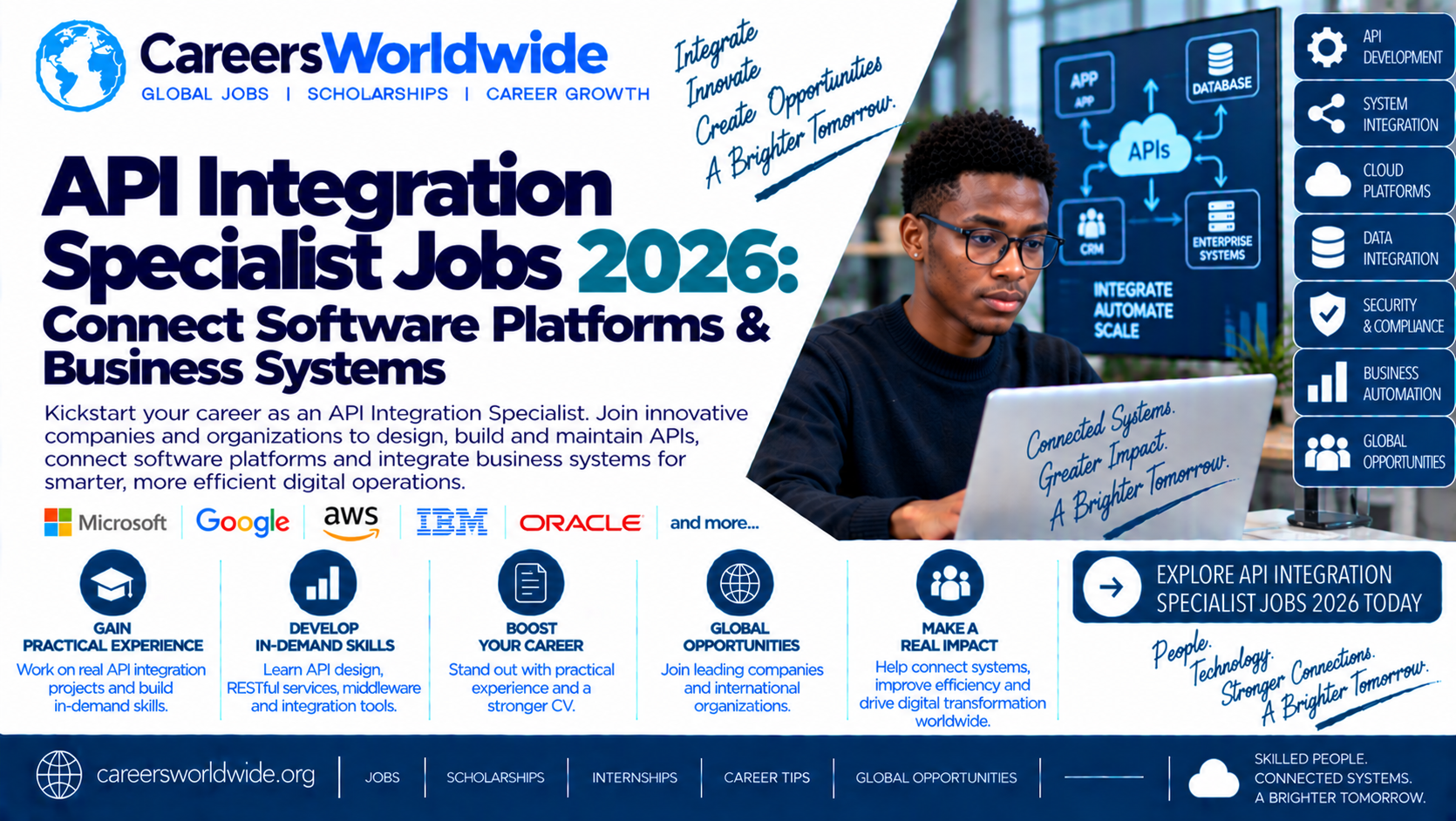
API Integration Specialist Jobs 2026 career guide connecting software platforms and business systems
SEO keywords
API Integration Specialist Jobs 2026, API integration jobs, API integration careers, API developer jobs 2026, integration engineer jobs, systems integration engineer, REST API developer, API support engineer, cloud integration jobs, middleware developer jobs, enterprise integration careers, MuleSoft developer jobs, Azure integration jobs, API management engineer, software integration specialist, API integration skills, API integration qualifications, OAuth 2.0, REST APIs, OpenAPI, Postman, JSON, webhooks, API testing, business systems integration, remote API integration jobs, junior API developer, graduate integration engineer, CareersWorldwide
ALSO CHECK: Payments Operations Analyst Jobs 2026: Support Digital Payments & Transaction ProcessingSeptember 22, 2026
AML Transaction Monitoring Jobs 2026: Support Financial Crime ComplianceSeptember 22, 2026
Treasury Operations Jobs 2026: Support Cash Management & Liquidity ReportingSeptember 22, 2026