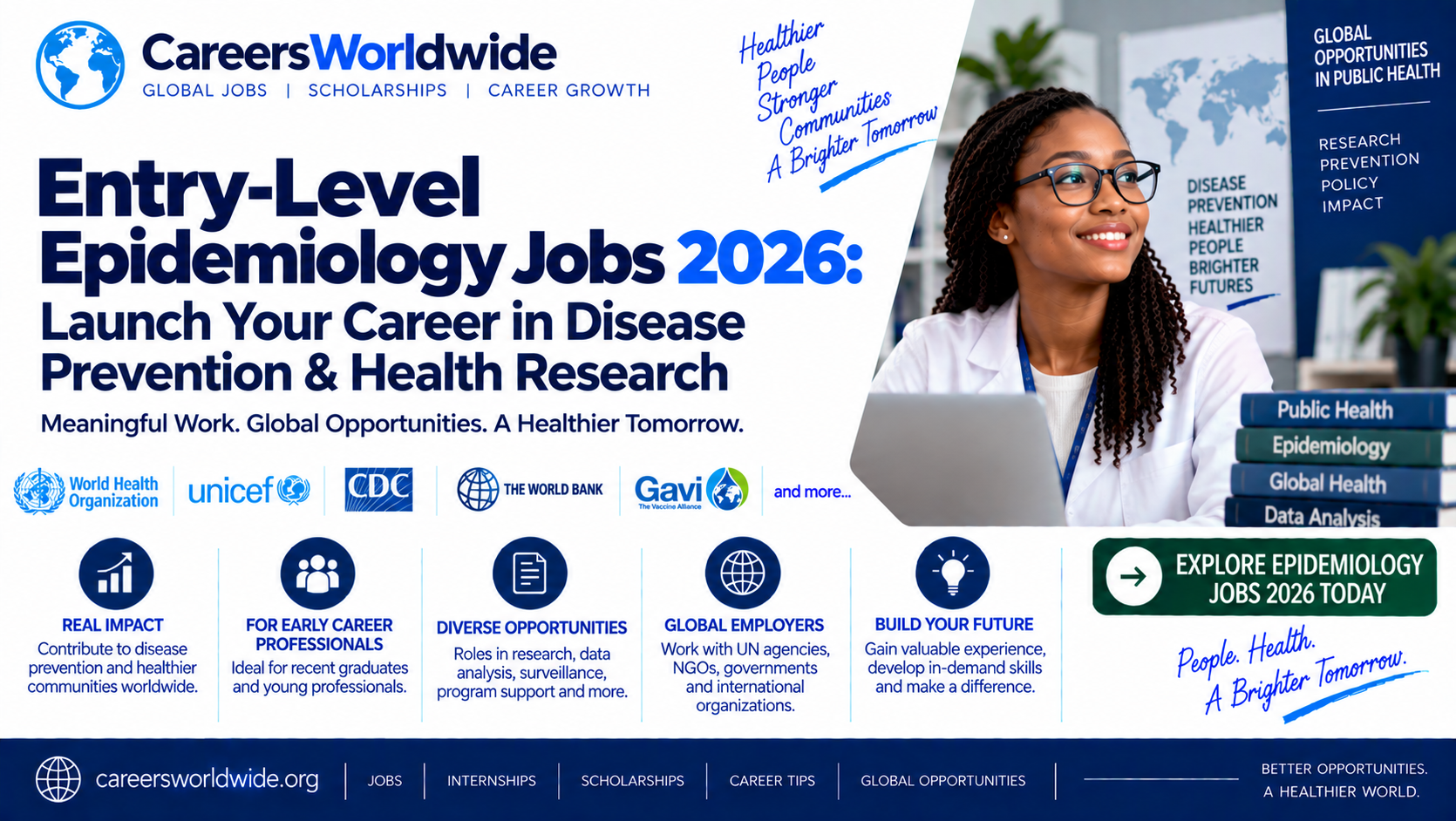

Excerpt: Entry-Level Epidemiology Jobs 2026 offer graduates and early-career public health professionals an opportunity to build careers in disease surveillance, outbreak investigation, health research, data analysis, and disease prevention. Explore epidemiology career paths, qualifications, essential skills, employers, entry-level opportunities, application strategies, and where to find public health jobs in 2026.
Introduction: Why Epidemiology Is a Growing Career Field in 2026
Epidemiology sits at the heart of modern public health.
When health authorities need to understand why a disease is spreading, which populations are most affected, whether an intervention is working, or how an outbreak should be controlled, epidemiological evidence plays a critical role.
This makes epidemiology an attractive career option for graduates who enjoy science, research, statistics, data analysis, and solving complex health problems.
Entry-Level Epidemiology Jobs 2026 can provide opportunities across government health agencies, hospitals, universities, research institutions, international organizations, NGOs, laboratories, pharmaceutical companies, and public health programs.
An epidemiologist may investigate disease patterns, analyze health data, design or support research studies, monitor outbreaks, evaluate interventions, or communicate evidence to decision-makers.
The U.S. Bureau of Labor Statistics describes epidemiologists as public health workers who investigate patterns and causes of disease and injury. Its latest Occupational Outlook Handbook projects employment for epidemiologists to grow 19% from 2025 to 2035, considerably faster than the average for all occupations.
However, graduates should understand that the title “epidemiologist” does not represent the only entry point into this field.
Many early-career professionals begin in related positions such as research assistant, surveillance assistant, public health analyst, data analyst, research coordinator, disease-control program assistant, or monitoring and evaluation roles.
This creates multiple routes into an epidemiology career.
For students and recent graduates, the most important strategy is to develop a combination of epidemiological knowledge, quantitative skills, research experience, and practical public health exposure.
This article explains the major career opportunities to explore in 2026, the qualifications employers may require, technical skills worth learning, ways to gain experience, and how to find legitimate epidemiology and public health opportunities.
Important: This is an independent career-information article and is not an employer announcement. Specific vacancies, eligibility requirements, salaries, locations, and closing dates vary by organization. Always verify current information through the official employer’s career portal before applying.
What Does an Epidemiologist Do?
An epidemiologist studies the distribution, causes, risk factors, and control of diseases and other health-related conditions within populations.
The work can involve both laboratory and non-laboratory activities, depending on the specialization.
Typical responsibilities can include:
- Monitoring disease trends
- Analyzing health datasets
- Investigating outbreaks
- Conducting literature reviews
- Designing research studies
- Collecting and cleaning data
- Identifying risk factors
- Preparing epidemiological reports
- Evaluating health interventions
- Communicating findings
- Supporting disease surveillance
- Working with public health teams
CDC describes epidemiologists as professionals who investigate how diseases spread and how they can be prevented or controlled.
This makes epidemiology particularly relevant to global challenges involving infectious diseases, chronic diseases, environmental health, maternal and child health, injuries, nutrition, mental health, and emerging health threats.
Entry-Level Epidemiology Jobs to Explore in 2026
Graduates should search using several related job titles rather than limiting themselves to “Junior Epidemiologist.”
1. Junior Epidemiologist
A junior epidemiologist may support senior epidemiologists with research, surveillance, data analysis, and reporting.
Responsibilities can include:
- Collecting epidemiological data
- Performing basic statistical analyses
- Preparing reports
- Supporting investigations
- Conducting literature reviews
- Maintaining surveillance databases
- Creating charts and tables
Depending on the employer, a Master’s degree in public health or a related field may be required.
2. Epidemiology Research Assistant
Research assistants support studies investigating diseases, health outcomes, interventions, or population health.
This can be an excellent starting point for graduates who want to build research experience.
Responsibilities may include:
- Literature searches
- Data collection
- Data entry
- Data cleaning
- Survey support
- Statistical analysis
- Research documentation
- Report preparation
Research assistant positions can be found at universities, research institutes, hospitals, NGOs, and public health organizations.
3. Public Health Data Analyst
Data analysis is increasingly important in epidemiology.
Public health data analysts may work with large datasets to identify trends and provide information for public health programs.
Useful technical skills include:
- Excel
- R
- Python
- SQL
- Stata
- SAS
- Power BI
- Tableau
You do not need to master every tool.
Instead, choose one statistical programming language and one data visualization tool and develop strong practical skills.
4. Disease Surveillance Assistant
Disease surveillance professionals help monitor health conditions across populations.
They may work with:
- Case reports
- Laboratory results
- Hospital data
- Community health data
- Disease registries
- Public health databases
This career path can provide valuable experience for people interested in outbreak response and applied epidemiology.
5. Public Health Research Assistant
Public health research assistants may support projects that are broader than epidemiology but still involve population health.
Projects can cover:
- Infectious diseases
- Chronic diseases
- Health behavior
- Environmental health
- Maternal health
- Child health
- Nutrition
- Health systems
This can be a strong stepping stone toward a specialized epidemiology position.
6. Research Coordinator
Research coordinators help organize studies and ensure that projects remain on schedule.
Their work can involve:
- Coordinating participants
- Maintaining study documentation
- Scheduling research activities
- Managing databases
- Supporting ethics requirements
- Preparing reports
- Communicating with research teams
This role is particularly useful for graduates who enjoy organization and research management.
7. Infection Prevention and Control Assistant
Healthcare facilities need professionals who can help monitor and reduce healthcare-associated infections.
Responsibilities may include:
- Monitoring infection indicators
- Supporting data collection
- Reviewing infection trends
- Preparing reports
- Supporting staff education
- Assisting infection-control teams
Candidates with epidemiology, nursing, public health, microbiology, or related backgrounds may find this area interesting.
8. Monitoring and Evaluation Assistant
Monitoring and evaluation roles are common within public health and international development organizations.
M&E professionals measure whether programs are achieving their objectives.
Responsibilities may include:
- Collecting program data
- Maintaining indicators
- Supporting evaluations
- Checking data quality
- Creating reports
- Developing dashboards
- Tracking health outcomes
M&E experience can be particularly valuable for graduates seeking careers with NGOs or international organizations.
Who Can Apply for Epidemiology Jobs?
Educational requirements vary.
Commonly relevant degrees include:
- Epidemiology
- Public Health
- Global Health
- Biostatistics
- Statistics
- Health Sciences
- Medicine
- Nursing
- Environmental Health
- Biomedical Sciences
- Health Informatics
- Microbiology
- Social Sciences
However, professional epidemiologist positions frequently require postgraduate education.
The U.S. Bureau of Labor Statistics states that epidemiologists typically need at least a master’s degree, often a Master of Public Health or related qualification.
This is an important distinction for graduates.
A Bachelor’s degree may qualify you for certain public health research, data, surveillance, assistant, or trainee roles, but a Master’s degree can be important for progressing into dedicated epidemiologist positions.
Essential Skills for an Epidemiology Career
Epidemiological Methods
You should understand concepts such as:
- Incidence
- Prevalence
- Risk
- Rates
- Bias
- Confounding
- Association
- Causation
- Study design
- Sampling
- Surveillance
These concepts form the foundation of epidemiological reasoning.
Statistical Analysis
Epidemiologists need to interpret data.
Useful skills include:
- Descriptive statistics
- Regression
- Confidence intervals
- Hypothesis testing
- Statistical significance
- Data visualization
- Basic epidemiological calculations
Statistical Software
R and Python are increasingly useful for data analysis.
Stata and SAS are also commonly encountered in research and public health environments.
Do not try to learn everything at once.
A graduate who can confidently clean a dataset, conduct an analysis, produce visualizations, and explain the findings is often better positioned than someone who lists six programming languages without practical experience.
Research Skills
Research skills are essential.
Practice:
- Searching scientific databases
- Reviewing academic papers
- Evaluating evidence
- Summarizing findings
- Designing research questions
- Writing research reports
Communication
Epidemiological findings need to be communicated to people who may not have technical backgrounds.
An epidemiologist might need to explain a disease trend to:
- Health officials
- Community organizations
- Hospital administrators
- Policymakers
- Journalists
- Program managers
The ability to communicate complex information clearly is therefore extremely valuable.
How to Gain Epidemiology Experience Before Your First Job
One of the biggest challenges facing graduates is the demand for experience.
You can begin building relevant experience before securing your first full-time position.
Build a Public Health Data Project
Use an open health dataset to investigate a specific question.
For example:
“What factors are associated with differences in disease prevalence?”
Your project could demonstrate:
- Data cleaning
- Descriptive statistics
- Data visualization
- Statistical analysis
- Interpretation
- Public health recommendations
Add the project to your professional portfolio.
Participate in Research
University research projects can provide useful experience.
Ask lecturers, professors, hospitals, research centers, or public health organizations whether they have opportunities for research assistance.
Even a short-term research project can help demonstrate practical experience.
Volunteer in Public Health
Volunteer opportunities may involve:
- Health education
- Community surveys
- Disease prevention campaigns
- Data collection
- Health promotion
- Community outreach
Document the specific responsibilities and results of your work.
Complete an Epidemiology Course
If your undergraduate degree is not specifically focused on epidemiology, consider taking additional coursework in:
- Epidemiological methods
- Biostatistics
- Research methods
- Data analysis
- Public health surveillance
These courses can help demonstrate commitment to the field.
Epidemiology Jobs in Government
Government health agencies are major employers of epidemiologists and public health professionals.
Potential work areas include:
- Disease surveillance
- Outbreak response
- Immunization programs
- Chronic disease prevention
- Environmental health
- Health statistics
- Emergency preparedness
- Public health research
The U.S. CDC is one example of a major public health employer. Its career portal states that it hires both entry-level and experienced professionals across numerous career fields, including health science and public health.
CDC also offers public health training and fellowship pathways. Its Public Health Associate Program, for example, is a two-year paid training program designed to prepare recent graduates for the public health workforce.
Eligibility for U.S. government programs varies, so international applicants should always check the nationality and work authorization requirements of individual opportunities.
Epidemiology Careers With International Organizations
International organizations provide another potential career pathway.
The World Health Organization employs professionals across public health, health emergencies, research, technical programs, data management, and other areas.
WHO states that it offers opportunities across its global workforce and includes professional positions as well as internships, fellowships, Junior Professional Officer opportunities, and other talent programmes.
WHO’s current global career portal allows candidates to search vacancies by location, organization, job field, employment type, schedule, and job level.
This makes WHO an important official source for graduates interested in global public health careers.
Epidemiology Jobs in Research and Universities
Universities and research institutions employ epidemiologists and related professionals to conduct studies.
Research areas may include:
- Infectious disease
- Cancer
- Cardiovascular disease
- Maternal health
- Child health
- Environmental exposures
- Occupational health
- Mental health
- Nutrition
- Global health
Entry-level research positions can help graduates develop the evidence-based skills required for more advanced epidemiology careers.
Epidemiology Careers in NGOs
NGOs frequently operate public health programs in communities affected by poverty, disease, humanitarian crises, and limited access to healthcare.
Potential positions include:
- Public health officer
- Epidemiology assistant
- Research assistant
- Surveillance officer
- M&E assistant
- Health program assistant
- Data analyst
- Health information officer
Experience with an NGO can be particularly valuable for graduates who eventually want to work in global health.
Emerging Areas of Epidemiology
Epidemiology is not limited to infectious disease.
Chronic Disease Epidemiology
This area examines conditions such as:
- Cancer
- Diabetes
- Cardiovascular disease
- Respiratory disease
- Obesity
Environmental Epidemiology
Professionals investigate relationships between environmental exposures and health.
Topics can include:
- Air pollution
- Water quality
- Climate-related health risks
- Chemical exposure
- Occupational hazards
Digital Epidemiology
Digital health technologies and large datasets are creating new opportunities for analyzing population health.
Professionals may work with:
- Electronic health records
- Digital surveillance
- Mobile health data
- Online health information
- Artificial intelligence
- Geographic information systems
Genomic Epidemiology
Genomic data can help researchers understand how pathogens evolve and spread.
This area combines epidemiology, genomics, laboratory science, and computational analysis.
Field Epidemiology
Field epidemiologists investigate health events in real-world settings.
This can involve outbreak investigations, surveillance, interviews, data collection, and rapid response.
Remote Epidemiology Jobs
Not every epidemiology position can be performed remotely.
Field investigations, laboratory work, hospital-based roles, and community programs generally require physical presence.
However, some activities can potentially be performed remotely or through hybrid arrangements, including:
- Data analysis
- Statistical research
- Literature reviews
- Report writing
- Surveillance analysis
- Research coordination
- Health informatics
- Program monitoring
International applicants should carefully check remote-work restrictions because “remote” does not necessarily mean “work from anywhere in the world.”
How to Build a Strong Epidemiology CV
A graduate CV should focus on evidence rather than simply listing subjects studied.
Professional Summary
Briefly describe your education, public health interests, analytical abilities, and career goal.
Technical Skills
Highlight relevant tools such as:
- R
- Python
- Stata
- SAS
- SQL
- Excel
- GIS
- Power BI
Research Experience
Include:
- Dissertation
- Research projects
- Data analysis
- Literature reviews
- Research assistantships
Public Health Experience
Include internships, volunteer work, community projects, and public health placements.
Quantify Your Work
Instead of:
“Analyzed health data.”
Write:
“Cleaned and analyzed a dataset containing more than 10,000 records to identify trends in selected public health indicators.”
Specific details make your contribution easier to understand.
How to Prepare for an Epidemiology Interview
Interviewers may test your understanding of both epidemiological concepts and practical problem-solving.
Potential questions include:
“How would you investigate an increase in disease cases?”
A strong answer could include:
- Verify the increase.
- Confirm the case definition.
- Check the quality of surveillance data.
- Establish the time, place, and person distribution.
- Develop hypotheses.
- Collect additional information.
- Analyze risk factors.
- Implement appropriate control measures.
- Communicate findings.
- Continue monitoring.
You may also be asked about study design, bias, confounding, statistics, data management, or research ethics.
Practice explaining technical concepts in simple language.
Summary Table: Entry-Level Epidemiology Jobs 2026
| Job Category | Main Focus | Useful Background | Key Skills |
|---|---|---|---|
| Junior Epidemiologist | Disease investigation | Epidemiology/Public Health | Statistics, surveillance |
| Epidemiology Research Assistant | Research studies | Public Health/Health Sciences | Research, data |
| Public Health Data Analyst | Health data | Statistics/Data Science | R, Python, SQL |
| Disease Surveillance Assistant | Disease monitoring | Public Health/Epidemiology | Data management |
| Public Health Research Assistant | Population health research | Public Health | Research methods |
| Research Coordinator | Study management | Health Sciences/Public Health | Organization, communication |
| Infection Prevention Assistant | Healthcare infections | Public Health/Clinical fields | Surveillance, analysis |
| M&E Assistant | Program performance | Public Health/Development | Indicators, reporting |
| Health Information Assistant | Health information systems | Health Informatics/Public Health | Databases, data quality |
Salary and Career Outlook
Salary varies significantly by country, employer, specialization, education, and experience.
As a U.S. benchmark, the Bureau of Labor Statistics reports a median annual wage of $87,220 for epidemiologists in May 2025. It projects 19% employment growth between 2025 and 2035.
This figure should not be interpreted as a global entry-level salary.
Early-career positions can pay substantially differently depending on location and job title.
Applicants should therefore research salaries specific to their country and the individual employer.
The broader outlook is nevertheless encouraging. The combination of disease surveillance, healthcare data, emerging diseases, public health preparedness, and advances in healthcare technology continues to create demand for professionals who can analyze population-level health information.
Where to Apply for Epidemiology Jobs in 2026
World Health Organization
WHO’s official careers portal allows candidates to search current vacancies across the WHO system. The organization also offers internships and other talent pathways for students and young professionals.
Where to apply:
WHO Careers – Official Application Portal
Centers for Disease Control and Prevention
CDC maintains a dedicated careers platform covering health science, public health, research, training, fellowships, and other career areas.
Where to apply:
CDC Careers – Official Jobs Portal
CDC Public Health Training and Fellowship Opportunities
Recent graduates should also monitor CDC’s public health training programs. The Public Health Associate Program is specifically designed for recent graduates and combines paid employment with structured public health training and field experience.
Where to explore:
CDC Public Health Careers and Fellowships
Universities and Research Institutions
Search the official career pages of universities, medical schools, research institutes, hospitals, and public health research centers.
Look for titles such as:
- Research Assistant
- Research Associate
- Epidemiology Assistant
- Data Analyst
- Research Coordinator
- Public Health Analyst
Practical Application Checklist
Before submitting an application, check the following:
- Do you meet the education requirement?
- Is epidemiology or a related subject required?
- Have you highlighted statistics skills?
- Have you included research experience?
- Have you listed relevant software?
- Does your CV demonstrate public health experience?
- Have you customized your application?
- Have you checked the location requirement?
- Do you have the required work authorization?
- Have you confirmed the application deadline?
- Are you applying through the official website?
WHO advises applicants to review the qualifications and experience specified in each vacancy and submit accurate, complete information through its online recruitment platform. WHO also warns candidates that it never asks applicants for money during recruitment.
How to Stand Out as an Early-Career Candidate
Competition for public health jobs can be strong.
One of the best ways to differentiate yourself is to demonstrate that you can actually work with data and evidence.
For example, build a small epidemiology portfolio containing:
Project 1: Disease trend analysis
Project 2: Outbreak investigation simulation
Project 3: Public health dashboard
Project 4: Literature review
Project 5: Statistical analysis project
Each project should explain:
- The research question
- The dataset or evidence used
- The methodology
- The results
- The public health implications
This provides employers with tangible evidence of your skills.
Frequently Asked Questions
What is an entry-level epidemiology job?
It is an early-career position involving epidemiological research, disease surveillance, health data analysis, public health monitoring, or related activities.
Can I become an epidemiologist with a Bachelor’s degree?
Some related entry-level public health roles accept bachelor’s degree holders. However, the U.S. Bureau of Labor Statistics notes that epidemiologists typically need at least a master’s degree.
What degree is best for epidemiology?
Public health, epidemiology, biostatistics, statistics, health sciences, and related fields can provide useful preparation.
Is an MPH useful for an epidemiology career?
Yes. An MPH with an epidemiology or quantitative-methods concentration can provide relevant training for epidemiology careers.
Which software should an epidemiology student learn?
R, Python, Stata, SAS, SQL, Excel, and GIS can all be useful. Start with one statistical tool and develop practical proficiency.
Can I work in epidemiology without experience?
You can begin through internships, research assistantships, public health training programs, fellowships, surveillance roles, and other entry-level positions.
Are epidemiology jobs available internationally?
Yes. Public health organizations, universities, governments, NGOs, and international organizations recruit professionals for epidemiology and related roles. Eligibility varies by employer and country.
Are there remote epidemiology jobs?
Some data, research, surveillance-analysis, and reporting roles may be remote or hybrid. Field epidemiology and outbreak-response positions generally require on-site work.
Is epidemiology a good career in 2026?
Epidemiology can be a strong career for people interested in public health, science, research, and data. The U.S. BLS currently projects 19% employment growth for epidemiologists from 2025 to 2035.
Final Thoughts
Entry-Level Epidemiology Jobs 2026 can provide a meaningful starting point for graduates who want to use science and data to improve population health.
The career extends far beyond outbreak investigations.
Epidemiologists and related public health professionals work in disease surveillance, research, health analytics, infection prevention, chronic disease, environmental health, global health, health systems, and emergency preparedness.
For recent graduates, the most practical approach is to develop three areas simultaneously:
Public health knowledge + quantitative skills + practical experience.
A strong academic background is valuable, but employers also want evidence that candidates can analyze information, communicate findings, work with data, and contribute to real projects.
If you are just starting out, do not focus exclusively on vacancies titled “Epidemiologist.” Search for research assistant, surveillance assistant, public health analyst, data analyst, M&E assistant, research coordinator, and health information positions as well.
These roles can provide the experience needed to progress toward more specialized epidemiology positions.
WHO and CDC are two major organizations worth monitoring, while universities, government health departments, hospitals, research institutions, NGOs, and public health programs can provide additional pathways. WHO’s global portal currently supports searches across job fields and employment types, while CDC highlights both entry-level careers and public health training opportunities.
Where to Apply
CDC Health Scientist & Public Health Careers
Always verify the vacancy’s eligibility, location, qualifications, closing date, and application process on the official employer website.
This website is an independent career and job-information resource. It is not the employer and is not affiliated with WHO, CDC, universities, governments, or other organizations mentioned unless explicitly stated.
SEO Keywords
Entry-Level Epidemiology Jobs 2026, epidemiology jobs 2026, entry level epidemiologist jobs, epidemiology careers 2026, public health jobs 2026, graduate epidemiology jobs, epidemiology jobs for graduates, junior epidemiologist jobs, epidemiology research assistant jobs, public health research jobs, disease surveillance jobs, epidemiology careers, epidemiologist jobs worldwide, global health epidemiology jobs, public health analyst jobs, epidemiology data analyst jobs, infectious disease epidemiology jobs, public health research assistant jobs, epidemiology jobs with MPH, epidemiology jobs for international applicants, remote epidemiology jobs, epidemiology internships 2026, epidemiology fellowships 2026, health data analyst jobs, disease prevention jobs, outbreak investigation jobs, public health careers for graduates, epidemiology jobs with no experience, entry level public health jobs, health research jobs 2026, epidemiology salary, epidemiology qualifications, epidemiology degree jobs, MPH epidemiology jobs, biostatistics and epidemiology jobs, global epidemiology careers, WHO epidemiology jobs, CDC epidemiology jobs, disease surveillance careers, public health data careers
ALSO CHECK: 𝗖𝘇𝗲𝗰𝗵 𝗚𝗼𝘃𝗲𝗿𝗻𝗺𝗲𝗻𝘁 𝗦𝗰𝗵𝗼𝗹𝗮𝗿𝘀𝗵𝗶𝗽𝘀 𝟮𝟬𝟮𝟳/𝟮𝟬𝟮𝟴: 𝗘𝗹𝗶𝗴𝗶𝗯𝗶𝗹𝗶𝘁𝘆, 𝗦𝘁𝘂𝗱𝘆 𝗣𝗿𝗼𝗴𝗿𝗮𝗺𝗺𝗲𝘀, 𝗕𝗲𝗻𝗲𝗳𝗶𝘁𝘀 & 𝗛𝗼𝘄 𝘁𝗼 𝗔𝗽𝗽𝗹𝘆September 14, 2026
Home-Based Internships for Graduates 2026: Gain Global Experience Without RelocatingSeptember 14, 2026
Paid Home-Based Internships 2026: Build Your Career From the Comfort of HomeSeptember 14, 2026