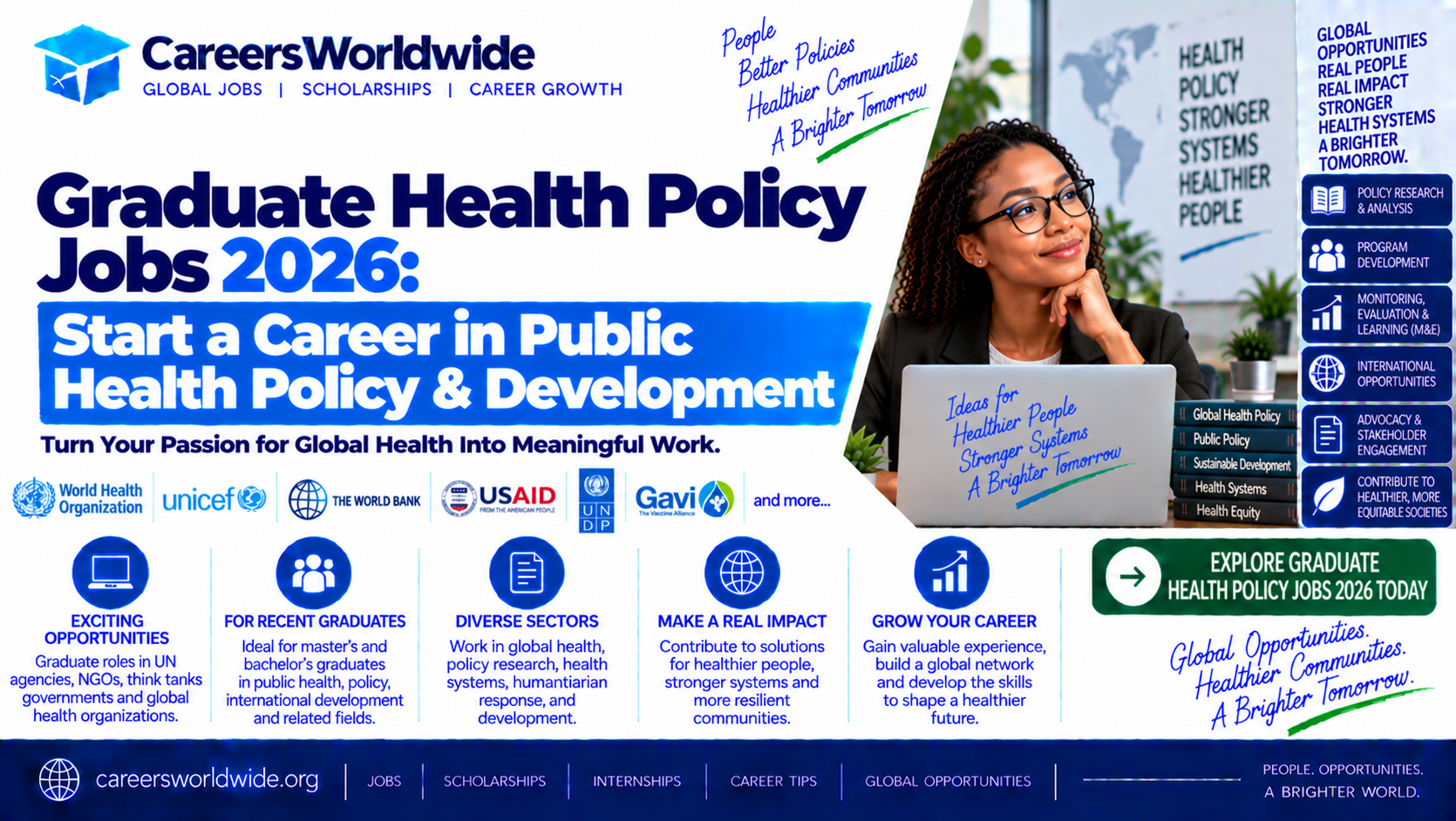

Excerpt: Graduate Health Policy Jobs 2026 offer an exciting entry point for recent graduates who want to influence healthcare systems, public health programs, government policy, and international development. Explore health policy careers, entry-level roles, qualifications, essential skills, employers, career pathways, and practical ways to strengthen your application.
Introduction: Why Graduate Health Policy Jobs Are Worth Exploring in 2026
Public health is about much more than hospitals, doctors, and medical treatment.
Behind many of the decisions that determine how healthcare services are funded, delivered, regulated, and improved are public health policy professionals.
Governments, international organizations, research institutions, universities, NGOs, foundations, and healthcare organizations all need people who can analyze evidence, understand health systems, conduct research, evaluate programs, and translate complex information into practical policy recommendations.
That is why Graduate Health Policy Jobs 2026 can provide an attractive career pathway for graduates interested in public health, international development, economics, political science, health administration, social sciences, research, and related disciplines.
Health policy professionals may work on issues such as healthcare access, health financing, disease prevention, health equity, maternal and child health, universal health coverage, health workforce planning, mental health, infectious diseases, environmental health, digital health, and emergency preparedness.
For graduates, the sector can offer several different entry points.
A first job might involve research and data analysis. Another graduate could begin as a program assistant, policy research assistant, monitoring and evaluation associate, health systems analyst, or public health project coordinator.
The important point is that a career in health policy does not necessarily begin with a job titled “Health Policy Analyst.”
Organizations frequently use different titles for positions involving policy research, program implementation, evidence analysis, stakeholder engagement, monitoring, and health systems development.
The World Health Organization, for example, describes public health work as covering country, regional, and headquarters-level activities, while its career system includes professional roles across health and related functions. WHO also provides internships and other talent pathways for students and recent graduates.
Meanwhile, UNDP’s career structure includes professional and expert positions such as analysts, specialists, officers, coordinators, and advisers, with health among its potential career streams.
This guide explores the types of graduate health policy opportunities to consider in 2026, the qualifications employers may seek, useful technical skills, where graduates can find opportunities, and how to build a competitive application.
Important: This article is an independent career and job-information resource. It is not an employer announcement and does not represent a specific vacancy unless explicitly stated. Vacancy requirements, deadlines, locations, and eligibility can change, so applicants should verify details through the official employer’s career portal.
What Is Health Policy?
Health policy refers to the decisions, strategies, laws, regulations, programs, and systems used to improve health and organize healthcare.
Health policy professionals help answer questions such as:
- How can healthcare services reach underserved populations?
- How should limited healthcare resources be allocated?
- Which public health interventions are most effective?
- How can governments improve healthcare quality?
- How can health inequalities be reduced?
- How should healthcare programs be evaluated?
- What policies can improve disease prevention?
- How can health systems respond to emergencies?
- How can evidence be translated into government action?
The work can therefore involve research, statistics, economics, public administration, program management, stakeholder engagement, communications, and policy analysis.
Types of Graduate Health Policy Jobs in 2026
Graduates should look beyond a single job title when searching for opportunities.
Here are some of the career categories worth exploring.
1. Graduate Health Policy Analyst
Health policy analysts research healthcare issues and help organizations understand the potential effects of different policies.
Entry-level responsibilities may include:
- Conducting policy research
- Reviewing academic literature
- Analyzing health data
- Preparing briefing documents
- Supporting policy recommendations
- Monitoring policy developments
- Preparing presentations
- Assisting senior analysts
Strong writing and analytical skills are particularly important.
2. Public Health Research Assistant
Research assistants support studies and projects examining health outcomes, healthcare systems, or population-level health challenges.
Tasks can include:
- Literature reviews
- Data collection
- Data cleaning
- Research summaries
- Interview preparation
- Survey administration
- Statistical analysis
- Report writing
- Citation management
Research experience gained through university projects can be valuable when applying for these roles.
3. Health Policy Research Associate
Research associates may support policy-focused studies conducted by think tanks, universities, NGOs, foundations, or international organizations.
They may investigate:
- Health financing
- Healthcare access
- Health equity
- Disease prevention
- Health workforce issues
- Universal health coverage
- Maternal and child health
- Health system performance
Candidates with strong research and writing abilities can be competitive for these positions.
4. Public Health Program Assistant
Program assistants support the implementation of public health initiatives.
Responsibilities can include:
- Coordinating meetings
- Maintaining project documentation
- Supporting reporting
- Tracking activities
- Communicating with stakeholders
- Assisting with budgets
- Organizing workshops
- Supporting monitoring activities
This can be a practical entry point for graduates who want to move into international development or health program management.
5. Health Systems Analyst
Health systems analysts examine how healthcare services are organized and delivered.
Their work can involve:
- Health system performance
- Service delivery
- Healthcare access
- Health financing
- Workforce planning
- Data analysis
- Process improvement
A background in public health, economics, health administration, statistics, or policy can be relevant.
6. Monitoring and Evaluation Associate
Monitoring and evaluation professionals measure whether health and development programs are achieving their intended results.
Graduate-level responsibilities may include:
- Collecting program data
- Maintaining indicators
- Supporting evaluations
- Preparing reports
- Checking data quality
- Creating dashboards
- Tracking program performance
M&E experience is particularly useful for graduates interested in NGO and international development careers.
7. Health Economics Research Assistant
Health economics focuses on how healthcare resources are allocated and how health interventions produce value.
Graduate roles may involve:
- Economic research
- Cost analysis
- Literature reviews
- Data analysis
- Health expenditure research
- Policy evaluation
Students with economics, statistics, mathematics, public health, or health economics backgrounds may find this career path attractive.
8. Global Health Program Associate
Global health organizations require professionals to support programs operating across countries and regions.
A graduate program associate might help with:
- Program planning
- Research
- Reporting
- Partnerships
- Monitoring
- Communications
- Stakeholder coordination
These positions can provide valuable experience for graduates hoping to pursue international development careers.
9. Policy Communications Assistant
Good policy is only useful when decision-makers and the public can understand it.
Policy communications professionals may transform technical research into:
- Policy briefs
- Reports
- Presentations
- Web content
- Stakeholder materials
- Advocacy documents
Graduates with a combination of public health and communications skills can therefore explore this niche.
Who Can Apply for Graduate Health Policy Jobs?
Requirements vary significantly depending on the organization and position.
Commonly relevant academic backgrounds include:
- Public Health
- Health Policy
- Health Administration
- Global Health
- International Development
- Economics
- Political Science
- Public Administration
- Sociology
- Statistics
- Epidemiology
- Social Sciences
- Development Studies
- International Relations
Some positions require a master’s degree, while others accept bachelor’s degree graduates.
Applicants should always read the individual vacancy requirements rather than assuming that all policy positions have the same educational expectations.
Essential Skills for Health Policy Careers
A successful health policy professional needs more than an interest in healthcare.
Research Skills
Policy work depends heavily on evidence.
You should be comfortable:
- Searching academic literature
- Evaluating sources
- Comparing evidence
- Identifying reliable datasets
- Summarizing research
- Finding gaps in evidence
Data Analysis
You do not necessarily need to become a data scientist.
However, understanding basic quantitative analysis can significantly strengthen your profile.
Useful skills include:
- Excel
- Statistics
- Data visualization
- SQL
- R
- Stata
- Python
- Power BI
The most appropriate tool depends on the role.
Policy Writing
Being able to write clearly is one of the most important skills in health policy.
A policy professional may need to turn a 50-page research report into a two-page briefing note that a government official can understand quickly.
Practice writing concise summaries, recommendations, and evidence-based arguments.
Communication
Health policy is highly collaborative.
Professionals may work with:
- Government officials
- Researchers
- Healthcare professionals
- NGOs
- Community organizations
- Donors
- International organizations
- Academic institutions
Strong communication can therefore be as important as technical knowledge.
Project Management
Many policy positions are connected to programs and projects.
Understanding project planning, timelines, deliverables, risks, budgets, and stakeholder management can make a graduate more competitive.
How to Gain Health Policy Experience Before Your First Job
One of the biggest challenges for recent graduates is the classic requirement for experience.
The solution is to create evidence of your capabilities before securing your first full-time position.
Complete a Policy Research Project
Choose a current health issue in your country or region and produce a short policy analysis.
For example:
Topic: Improving access to primary healthcare in rural communities.
Your project could include:
- Problem definition
- Existing evidence
- Current policy environment
- Key challenges
- Potential interventions
- Stakeholder analysis
- Recommendations
- Implementation considerations
This demonstrates research, analytical thinking, writing, and policy skills.
Volunteer With a Public Health Organization
Volunteer experience can expose you to real-world health programs.
Look for opportunities involving:
- Community health
- Health education
- Research
- Data collection
- Program administration
- Advocacy
- Monitoring and evaluation
Document what you actually accomplished rather than simply listing the organization.
Use Your University Dissertation
If you recently completed a dissertation or major research project, consider turning it into a portfolio piece.
Highlight:
- Research question
- Methodology
- Data
- Findings
- Recommendations
This can give employers concrete evidence of your analytical ability.
Health Policy Jobs With International Organizations
International organizations can provide attractive career pathways for graduates interested in global health and development.
The WHO careers system includes vacancies across its global workforce and provides opportunities for students and recent graduates through internships and other talent programs.
UNDP also offers several types of opportunities, including internships, international and national staff positions, Junior Professional Officer positions, UN Volunteers opportunities, and its Graduate Programme.
The UNDP Graduate Programme is particularly relevant to graduates interested in international development. UNDP describes it as an entry-level pathway for young graduates, with assignments across country, regional, and headquarters offices and a programme-and-policy stream.
However, applicants should never assume that an international organization vacancy is automatically open to all nationalities.
Always read the eligibility and duty-station requirements.
Graduate Health Policy Jobs in NGOs
Non-governmental organizations are another important source of public health policy and development careers.
NGOs may hire graduates for roles related to:
- Health programs
- Policy advocacy
- Research
- Monitoring and evaluation
- Community health
- Program coordination
- Health systems
- Humanitarian response
An NGO position can provide valuable practical experience that later helps candidates move into larger international organizations, government agencies, foundations, or research institutions.
Graduate Health Policy Jobs in Government
Government departments and public agencies are central to health policy.
Potential areas include:
- Ministry of Health
- Public health agencies
- Health planning departments
- Healthcare regulatory bodies
- National statistics agencies
- Social protection programs
- Local government
- Public hospitals
Government experience can be particularly valuable because it provides direct exposure to policy implementation.
Graduate Health Policy Jobs in Research Institutions
Universities, research institutes, think tanks, and policy centers employ researchers who study healthcare and development issues.
Entry-level roles may include:
- Research assistant
- Research associate
- Policy assistant
- Data analyst
- Program assistant
- Project coordinator
For graduates who enjoy academic research, this can be one of the strongest pathways into policy.
Remote Health Policy Jobs
Some policy and research positions can be performed remotely or through hybrid arrangements.
Potentially remote-friendly tasks include:
- Literature reviews
- Data analysis
- Policy research
- Report writing
- Communications
- Program coordination
- Monitoring and evaluation
However, public health work can also require field visits, stakeholder meetings, country-specific knowledge, or access to secure information.
Therefore, applicants should not assume that a position advertised as “remote” automatically permits international work from any country.
Check the exact location and work authorization requirements before applying.
How to Write a Strong Health Policy CV
Your CV should demonstrate evidence-based thinking.
For a recent graduate, a strong structure could include:
Professional Profile
Write two or three sentences describing your academic background, policy interests, technical skills, and career direction.
Education
Include your degree, university, graduation date, and relevant coursework.
Research Experience
Highlight:
- Dissertation
- Research projects
- Data analysis
- Literature reviews
- Policy assessments
Technical Skills
List relevant tools such as:
- Excel
- R
- Stata
- Python
- SQL
- Power BI
- Statistical analysis
Relevant Experience
Include internships, volunteering, student projects, research assistant work, and community activities when relevant.
Achievements
Use measurable accomplishments whenever possible.
Instead of:
“Assisted with a health research project.”
Consider:
“Reviewed 40+ academic sources and synthesized evidence for a university research project examining barriers to primary healthcare access.”
The second example gives the employer much more information.
How to Prepare for a Health Policy Interview
Health policy interviews often test both technical knowledge and analytical thinking.
You may be asked questions such as:
“What public health issue do you believe requires greater policy attention?”
Do not simply state an opinion.
Structure your response around:
- The problem
- Evidence
- Existing policies
- Gaps
- Potential solutions
- Implementation challenges
You may also receive a case study.
For example, you might be asked to recommend ways to improve vaccination coverage.
A strong answer could discuss:
- Access
- Cost
- Public awareness
- Healthcare infrastructure
- Workforce
- Supply chains
- Community trust
- Data systems
- Monitoring
This demonstrates that you understand health policy as a systems problem rather than a single intervention.
Summary Table: Graduate Health Policy Jobs 2026
| Job Category | Typical Responsibilities | Useful Background | Key Skills |
|---|---|---|---|
| Health Policy Analyst | Policy research and analysis | Public Health, Policy, Economics | Research, writing, analysis |
| Research Assistant | Research and evidence gathering | Public Health, Social Sciences | Literature review, data |
| Policy Research Associate | Policy studies and reports | Public Policy, Global Health | Research, writing |
| Public Health Program Assistant | Program coordination | Public Health, Development | Organization, communication |
| Health Systems Analyst | Health system analysis | Public Health, Economics | Data, systems thinking |
| M&E Associate | Program monitoring | Public Health, Development | Indicators, data analysis |
| Health Economics Assistant | Economic research | Economics, Health Economics | Statistics, research |
| Global Health Associate | International health programs | Global Health, Development | Coordination, research |
| Policy Communications Assistant | Policy communication | Communications, Public Health | Writing, presentation |
Where to Apply for Graduate Health Policy Jobs 2026
Applicants should prioritize official career portals when searching for opportunities.
World Health Organization
WHO maintains an official careers platform where candidates can search vacancies and create application profiles. WHO advises applicants to review the requirements carefully and submit applications online before the stated deadline.
Where to apply: WHO Careers – Official Application Portal
United Nations Development Programme
UNDP publishes vacancies through its official careers system, including professional roles, internships, and other opportunities. Its recruitment guidance emphasizes checking minimum requirements and tailoring applications to the specific position.
Where to apply: UNDP Careers – Official Job Opportunities
UNDP Graduate Programme
Recent graduates interested in international development should also monitor the UNDP Graduate Programme. The programme is designed as an entry-level pathway for young graduates, although recruitment campaigns and eligibility requirements can change.
Where to apply: UNDP Graduate Programme
Practical Application Checklist
Before submitting a health policy application, check the following:
- Do you meet the minimum education requirement?
- Does your degree match the vacancy?
- Do you meet the experience requirement?
- Have you highlighted relevant research?
- Have you included analytical skills?
- Does your CV match the job description?
- Have you customized your cover letter?
- Have you checked the location requirement?
- Are you eligible to work in the advertised location?
- Have you confirmed the closing date?
- Are you applying through the official website?
UNDP specifically advises candidates to assess their qualifications against the vacancy requirements and tailor their online application, CV, and cover letter to the position.
WHO likewise advises applicants to review their qualifications and experience against the vacancy and stresses that applications must be submitted by the stated deadline.
Beware of Fake Health Policy Job Advertisements
International development and public health jobs can attract scammers.
Applicants should be cautious if someone asks for:
- Recruitment fees
- Visa processing payments
- Training fees
- Interview fees
- Registration charges
- Money to secure a position
UNDP explicitly warns that it does not charge candidates fees at any stage of recruitment.
WHO also warns candidates about fraudulent recruitment schemes and states that it does not ask applicants for money for recruitment.
Always verify the vacancy through the organization’s official website.
FAQ: Graduate Health Policy Jobs 2026
What degree do I need for a health policy job?
Common degrees include public health, health policy, global health, economics, political science, international development, statistics, social sciences, and health administration. Exact requirements depend on the vacancy.
Can I get a health policy job with a bachelor’s degree?
Yes. Some graduate and entry-level positions accept bachelor’s degree graduates. Others, particularly specialized policy or research positions, may require a master’s degree.
Is public health policy a good career?
It can be a strong career for people interested in healthcare systems, research, government, international development, and evidence-based decision-making.
What skills are most important for health policy?
Research, analytical thinking, policy writing, data analysis, communication, project management, and an understanding of health systems are particularly useful.
Can I work internationally with a health policy degree?
Yes. Health policy graduates can pursue opportunities with international organizations, NGOs, governments, universities, research institutions, and development agencies. Eligibility varies by position.
Are there remote health policy jobs?
Some research, data, writing, communications, and program roles can be remote or hybrid. However, many positions have country, time-zone, security, or work-authorization requirements.
Do I need work experience after graduation?
Not always. Graduate programs, internships, research assistant positions, volunteer work, and entry-level roles can provide pathways into the sector.
How can I stand out as a new graduate?
Develop a practical portfolio. Complete a policy research project, learn data analysis, gain research experience, improve your policy writing, and tailor each application to the specific vacancy.
Final Thoughts
Graduate Health Policy Jobs 2026 can provide a strong starting point for graduates who want to build careers in public health, healthcare systems, international development, and evidence-based policymaking.
The sector is broad, meaning graduates can approach it from several directions.
Some may begin with research and data. Others may enter through program coordination, monitoring and evaluation, health economics, communications, or health systems analysis.
The key is to avoid waiting for the perfect job title.
Instead, build transferable skills and gain practical experience that demonstrates your ability to research problems, analyze evidence, communicate findings, and contribute to health programs.
For graduates targeting organizations such as WHO, UNDP, NGOs, governments, universities, and research institutions, official career portals should remain the primary source for confirming vacancies and eligibility.
WHO currently provides multiple career pathways across its global workforce, while UNDP maintains opportunities across policy, programme, professional, graduate, internship, and other career streams.
Start by identifying one health policy area that genuinely interests you. Then build knowledge, develop practical skills, create evidence of your abilities, and apply consistently.
A first role may be an assistant or research position, but it can become the foundation for a long-term career in public health policy and international development.
SEO Keywords
Graduate Health Policy Jobs 2026, health policy jobs 2026, public health policy jobs, graduate public health jobs, entry level health policy jobs, health policy careers, public health careers 2026, graduate health jobs, public health policy careers, health systems jobs, global health jobs 2026, health policy analyst jobs, public health analyst jobs, health policy research jobs, health research assistant jobs, graduate global health jobs, international development health jobs, health economics jobs, monitoring and evaluation health jobs, public health research jobs, NGO health jobs 2026, WHO health policy jobs, UN health policy jobs, UNDP health jobs, healthcare policy careers, public health graduate jobs, entry level public health jobs, health systems analyst jobs, global health policy careers, health development jobs, health policy jobs for graduates, public health jobs for graduates, international health policy jobs, graduate health careers, public health development jobs
ALSO CHEK: Early Career Health IT Jobs 2026: Explore Digital Health, Healthcare Technology & Data CareersSeptember 14, 2026
Early Career Remote Jobs 2026: Global Work-From-Home Opportunities for GraduatesSeptember 13, 2026
Remote Proposal Writer Jobs 2026: International Careers in Business Development & CommunicationsSeptember 13, 2026